
 Finland
 Germany
 Denmark
 Sweden
 Italy
 Netherlands
 Norway












Introduction
Artificial intelligence (AI) often feels effortless from the user’s perspective. A prompt is entered, and a response appears within seconds. Behind that seemingly simple interaction, however, lies a vast and highly demanding physical infrastructure that makes modern AI possible.
The data center industry is undergoing a fundamental transformation. The traditional approach of building a facility, installing servers, and cooling them with conventional air-conditioning systems is no longer sufficient. Supporting AI at scale now requires balancing four tightly interconnected elements: computing power, thermal management, networking, and energy supply. A limitation in any one of these areas can affect the performance of the entire environment.
The Core Challenge: Density, Not Just Capacity
Discussions about AI infrastructure often focus on the enormous amount of electricity consumed by data centers. While total power consumption is important, infrastructure engineers face an even greater challenge: power density.
+————————————————————-+
| THE SPACE VS. THERMAL REALITY |
| |
| [ Legacy Data Center Room ] |
| 100 Racks @ 10 kW each = 1 Megawatt (Spread across a hall) |
| |
| [ Modern AI Data Center Room ] |
| 10 Racks @ 100 kW each = 1 Megawatt (Packed into one corner)|
+————————————————————-+
Traditional computing workloads spread power consumption across large sections of a facility. AI workloads concentrate the same amount of energy into a much smaller footprint. Individual AI processors can consume between 1,000 and 2,700 watts, and when dozens of these processors are installed within a single rack, heat output increases dramatically. At that point, managing thermal energy becomes just as important as supplying electrical power.
1. Cooling: Moving Beyond Air
As AI hardware becomes more powerful, thermal management becomes increasingly challenging. Conventional air cooling can no longer remove heat efficiently from today’s high-density AI servers.
To overcome this limitation, liquid cooling has become a key technology for modern AI infrastructure.
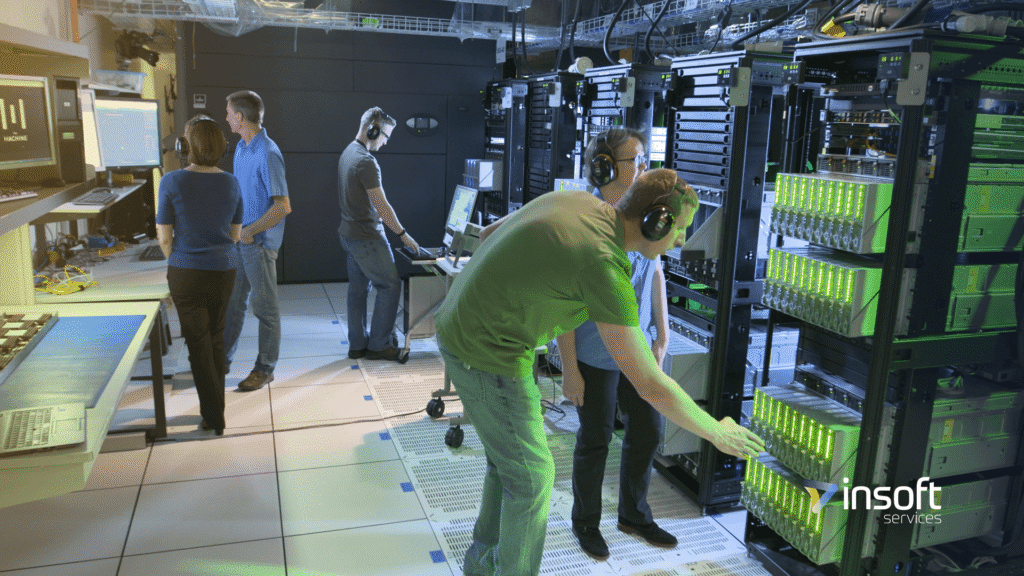
One of the most widely adopted approaches is Direct-to-Chip (DLC) cooling, where a closed-loop liquid cooling system circulates coolant through specially designed cold plates mounted directly on processors. Heat is captured at its source and transferred to heat exchangers for efficient removal or reuse.
[ Coolant Pump ] → ( Cold Plate on GPU ) → [ Heat Exchanger / Heat Reuse ]
The way data center efficiency is measured is evolving as well. For many years, Power Usage Effectiveness (PUE) served as the primary benchmark by comparing total facility energy consumption with the energy used by IT equipment.
AI workloads, however, require broader performance measurements. Many organizations are beginning to evaluate infrastructure using metrics such as tokens per watt, which consider computing performance, cooling efficiency, and workload execution together rather than assessing energy consumption alone.
2. Networking: Compute Depends on Connectivity
In traditional enterprise environments, networks primarily move information between users, applications, and databases. AI infrastructure places far greater demands on networking because communication between processors is part of the computing process itself.
Large language models are too large to run on a single GPU. Instead, thousands of processors work together simultaneously, each handling a portion of the workload while continuously exchanging data with the rest of the cluster.
Even extremely small increases in network latency can reduce overall performance. Lost packets or communication delays leave high-performance processors waiting instead of computing.
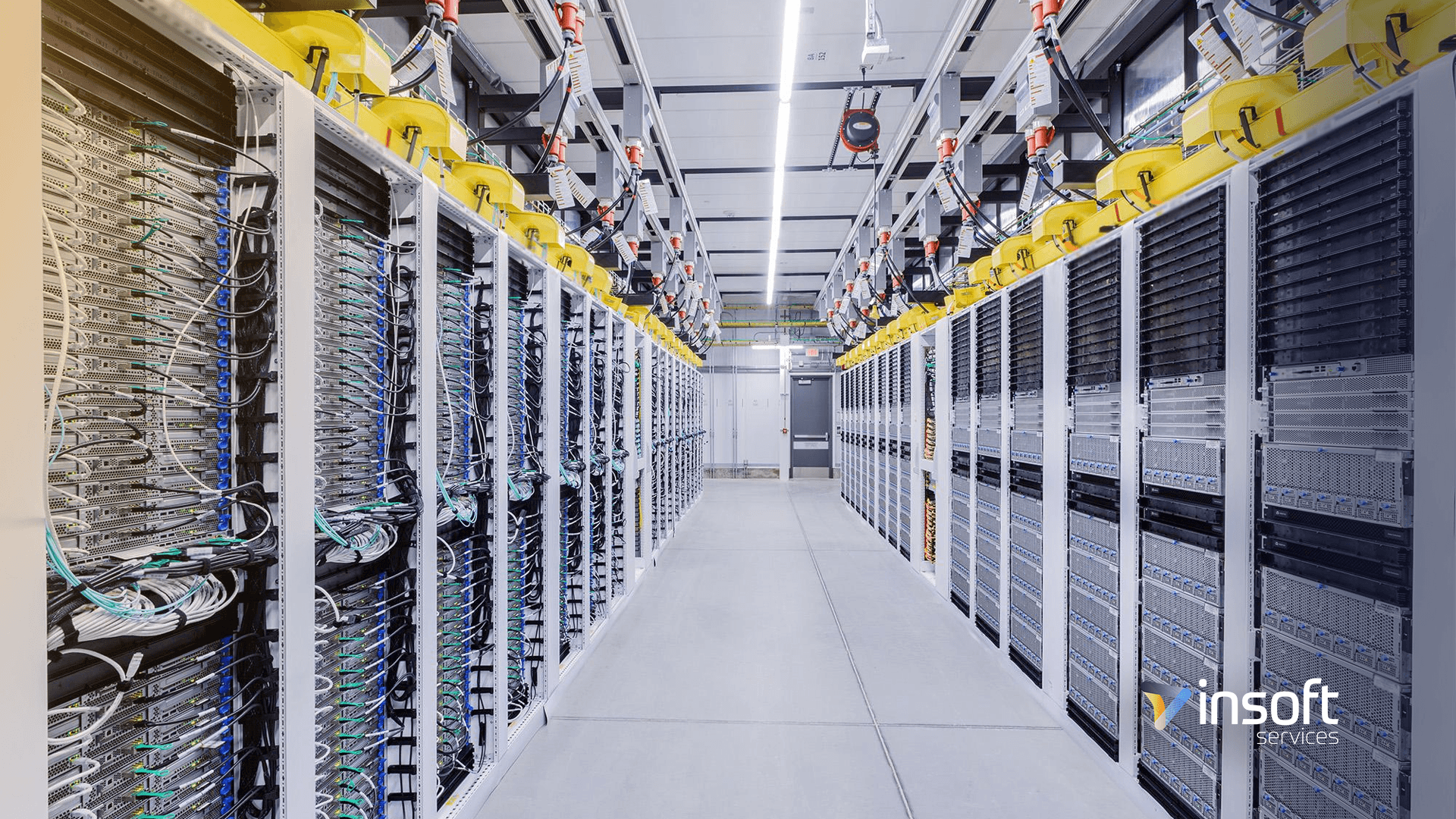
To minimize these interruptions, AI data centers deploy dense fiber-optic networks capable of carrying enormous volumes of data with extremely low latency. Specialized networking technologies keep processors synchronized, allowing AI clusters to operate at maximum efficiency.
3. Energy: The Infrastructure Constraint
Perhaps the greatest obstacle to AI expansion is not processor availability or software development—it’s reliable access to electrical power.
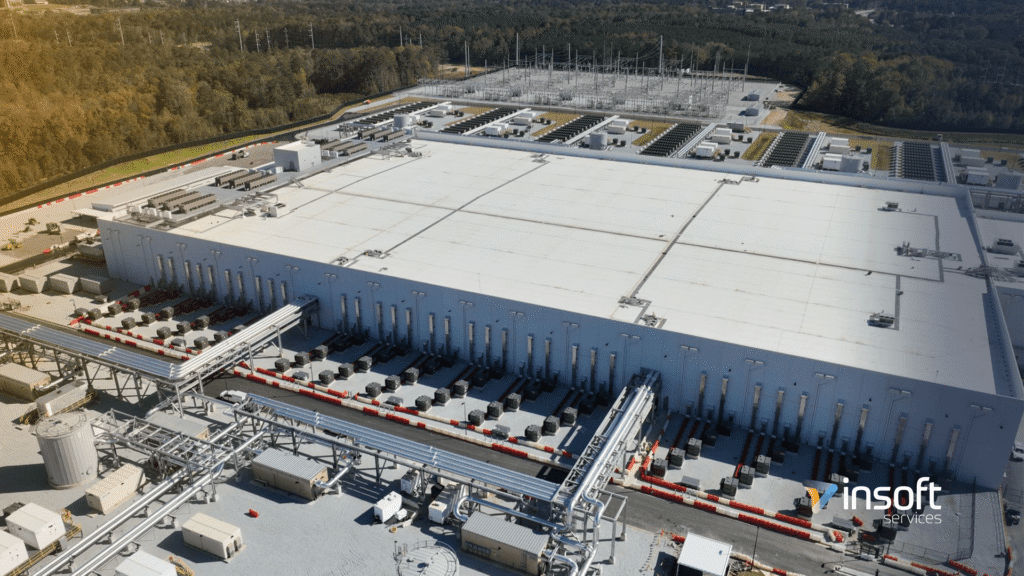
In many major data center regions, utility providers may require six to eight years to expand transmission capacity or build new high-voltage infrastructure. Because AI deployment moves much faster than utility upgrades, technology companies are increasingly investing in their own energy resources.
On-site power generation using dedicated natural gas turbines provides continuous electricity while reducing dependence on utility expansion schedules.
Battery Energy Storage Systems (BESS) allow facilities to store excess renewable energy, improve operational stability, and support local power grids during periods of peak demand.
Looking further ahead, organizations are also exploring Small Modular Reactors (SMRs) as a potential long-term source of reliable, carbon-free electricity capable of supporting future AI infrastructure.
A Unified Infrastructure Strategy
One of the most important lessons from AI infrastructure is that computing, cooling, networking, and power can no longer be designed independently.
A decision made at the processor level influences cooling requirements, network architecture, facility design, and electrical infrastructure. Building infrastructure for the next generation of AI demands a coordinated engineering strategy that brings together computing hardware, cooling technologies, high-speed networking, and reliable power systems.
The future of AI depends not only on more powerful algorithms but also on the physical infrastructure that enables them. Building that infrastructure will require coordinated advances in engineering, energy, networking, and data center design to ensure AI systems remain scalable, efficient, and reliable.
Keywords: Artificial Intelligence, AI Infrastructure, Data Centers, GPU, AI Processors, Direct-to-Chip Cooling, Liquid Cooling, Power Usage Effectiveness, PUE, Tokens per Watt, Fiber-Optic Networking, AI Networking, Battery Energy Storage System, BESS, Small Modular Reactor, SMR, Data Center Power, High-Density Computing, AI Engineering.

No Comments