
 Finland
 Germany
 Denmark
 Sweden
 Italy
Italy Netherlands
 Norway
















Business Case for Team NSE Certification: IT Leader Guide
If your Security Operations Center faced a sophisticated zero-day exploit today, would every analyst respond with identical precision, or would fragmented skill sets create a catastrophic delay in your defense? Success in building a business case for team-wide NSE certification starts with addressing these operational vulnerabilities through standardized, high-level proficiency.
Most leaders recognize that inconsistent expertise across a SOC team increases the risk of human error and accelerates staff turnover. It’s often difficult to present security training as a profit-driver when executives primarily focus on the bottom line and immediate fiscal outcomes rather than long-term technical resilience.
This guide provides the framework you need to secure executive buy-in by demonstrating clear ROI. You’ll learn how to quantify the value of standardizing your team’s skills through Fortinet’s official training pathways and Premier Authorized Training Centers.
We’ll examine how aligning your staff with official NSE certification levels reduces incident response times and creates a unified operational language. This strategic alignment ensures your global security posture remains resilient against evolving threats while fostering long-term organizational growth.
The Strategic Imperative: Why Team-Wide NSE Certification Matters
Transitioning from a collection of individual experts to a unified, resilient security organization is a necessity for modern IT leaders. Relying on a single “hero” analyst creates a single point of failure that your business cannot afford. When building a business case for team-wide NSE certification, you’re proposing a shift toward collective intelligence. This approach ensures that your defense remains robust even during staff transitions or complex multi-vector attacks.
The cybersecurity talent gap represents a significant financial risk; unfilled positions and high turnover lead to operational friction and increased mean time to respond (MTTR). By standardizing on the Fortinet NSE certification track, you provide a clear professional roadmap that keeps your team engaged and technically current against the threats projected for 2026. This proactive alignment with the Fortinet Security Fabric turns your personnel into a synchronized defensive layer.
Standardizing the Human Element of the Security Fabric
A shared technical language is the foundation of operational excellence. When your entire team understands the same protocols and command structures, the risk of misconfiguration drops significantly. Standardized training ensures that Zero Trust architectures are deployed consistently across the network, removing the ambiguity that often leads to security gaps. It’s about creating a “human firewall” that is as integrated as the hardware it manages.
Addressing the Talent Retention Challenge
Investing in your team’s growth is a powerful retention tool. Professionals are more likely to remain with an organization that actively funds their advancement through an Authorized Training Center. This commitment provides a competitive advantage in the recruitment market, as top-tier talent seeks environments where they can achieve high-level proficiency. You aren’t just buying training; you’re securing the loyalty of your most critical assets.
Quantifying the ROI: Financial and Operational Benefits
Quantifying return on investment requires moving beyond surface-level budget discussions. When building a business case for team-wide NSE certification, you should highlight the direct impact on Mean Time to Detect (MTTD) and Mean Time to Respond (MTTR). Certified teams act with greater speed and precision; these are metrics that underwriters value when determining cyber insurance premiums. Documented technical competency serves as a verifiable risk-mitigation factor that can lead to more favorable policy terms for your organization.
The “Cost of Inaction” is often the most compelling financial argument for leadership. A single breach resulting from a misconfigured SASE or SD-WAN environment can cost millions in remediation and lost productivity. By standardizing skills, you ensure that complex Fortinet deployments are managed with professional accuracy, maximizing the efficiency of your infrastructure.
Operational Efficiency and Incident Response
A team proficient in FortiOS administration and advanced security protocols can reduce troubleshooting hours by up to 30%. This efficiency stems from a deeper understanding of the Fortinet Security Fabric, which facilitates faster root-cause analysis. High NSE level proficiency correlates with reduced network downtime since engineers can resolve issues internally without escalating every anomaly to tier-three support or external vendor queues.
Long-Term Cost Savings and TCO
Developing internal expertise through a Premier Authorized Training Center significantly reduces your reliance on expensive external consultants for routine configuration changes. This strategic move lowers the Total Cost of Ownership (TCO) for your Fortinet hardware. You aren’t just buying equipment; you’re ensuring your team has the capability to extract every bit of value from that investment, transforming a capital expenditure into a high-performing operational asset.
A Framework for Your NSE Business Case Proposal
Drafting a proposal that resonates with executive stakeholders requires a ‘Bottom Line Up Front’ (BLUF) approach. When building a business case for team-wide NSE certification, you must clearly state how this initiative mitigates organizational risks like operational friction or configuration errors. Your proposal should map each technical milestone to a tangible business outcome, ensuring that leadership views certification as a strategic asset rather than a discretionary expense.
Mapping Certification Levels to Team Roles
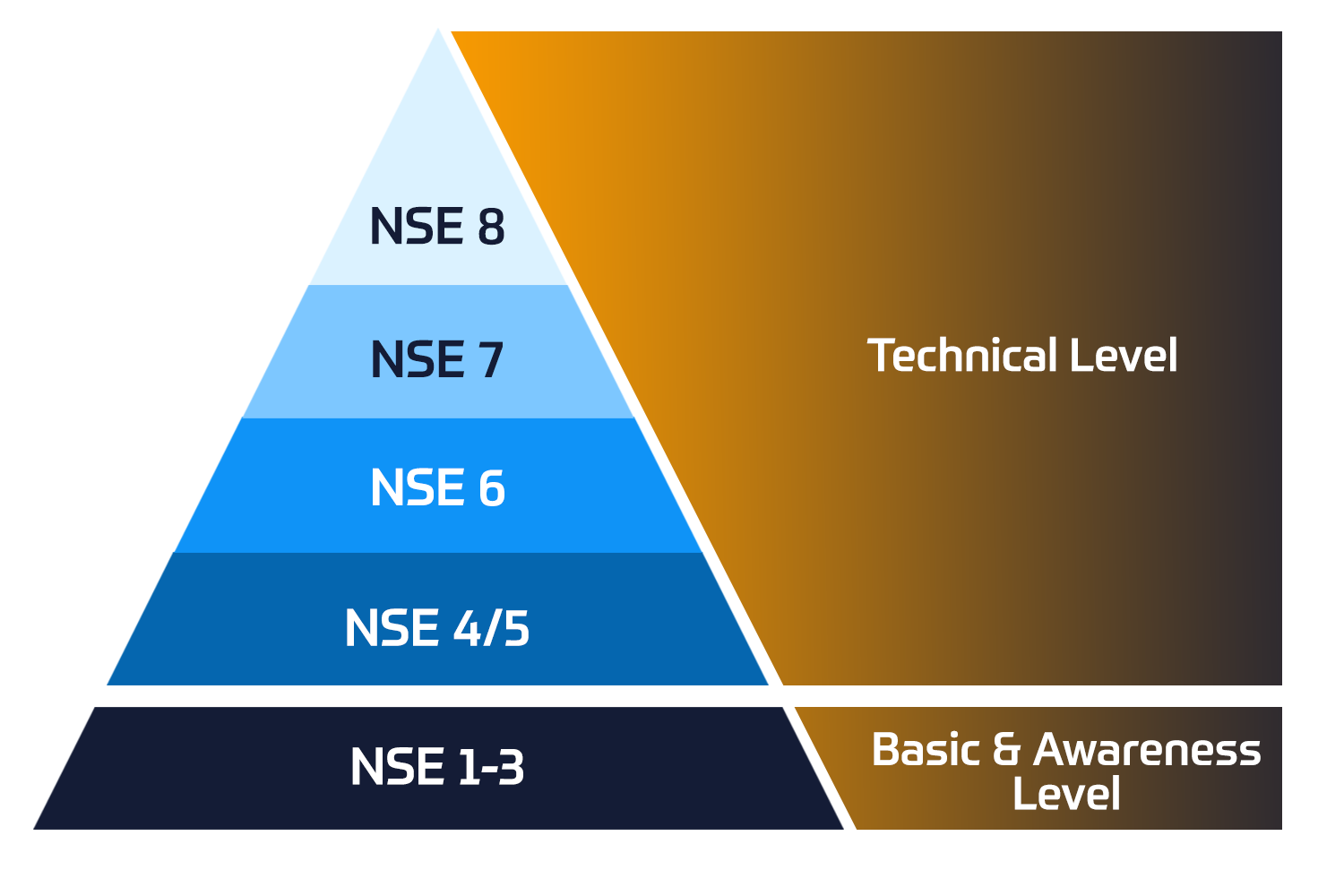
Precision in role assignment is vital for operational clarity. We recommend assigning NSE 4 through NSE 6 to your primary administrators to ensure core firewall and security management proficiency. Senior architects and lead security engineers should target NSE 7 and NSE 8 to master complex architecture and design. This structured hierarchy ensures that every team member possesses the specific technical depth required to uphold your organization’s security posture.
Risk Assessment and Mitigation Strategies
Leaders often express concern regarding operational coverage during training periods. Utilizing virtual instructor-led or on-demand formats through a Fortinet Premier Authorized Training Center allows for flexible scheduling that maintains SOC uptime. Address the concern of staff turnover by framing certification as a loyalty-building professional development benefit. The risk of maintaining an uncertified team in an evolving threat landscape far outweighs the potential of losing a trained professional. A phased rollout over 12 months provides a manageable cadence for achieving these critical milestones.
Execution: Partnering with an Authorized Training Center
Finalizing your proposal requires selecting a delivery partner that mirrors the excellence of your technical infrastructure. When building a business case for team-wide NSE certification, the distinction between official training and third-party alternatives is a critical risk factor. Unauthorized courses often lack the technical depth and hands-on laboratory access required to master the Fortinet Security Fabric. Partnering with a Premier Authorized Training Center (ATC) ensures your team receives instruction that is globally consistent, technically accurate, and officially recognized.
The Value of Authorized Fortinet Training
Official training provides your engineers with exclusive access to authorized labs and the most current exam versions for the 2026 certification cycle. This ensures that the skills your team develops are immediately applicable to your production environment. You’ll benefit from the reliability of learning from certified instructors who possess extensive real-world implementation experience. This level of expertise is indispensable for troubleshooting complex deployments. To align your team’s skills with official standards, you can explore the Fortinet certification track to identify the specific modules your organization requires.
Strategic Implementation and Next Steps
Large enterprise teams often require a customized approach rather than a generic curriculum. Professional consultancy helps you tailor the training path to your specific network architecture, whether you’re prioritizing SD-WAN, SASE, or Zero Trust. This strategic alignment ensures that your training investment directly supports your 2026 security objectives. Once you’ve defined these requirements, you can consult with a Premier Authorized Training Center to request a bespoke roadmap. Presenting a detailed, partner-backed implementation plan provides the final assurance your procurement team needs to authorize the investment and begin the rollout.
Securing Your Future Through Strategic Certification
Standardizing your security team’s expertise through official training is a fundamental step toward achieving organizational agility and resilience. By quantifying the reduction in incident response times and aligning technical roles with the Fortinet Security Fabric, you transform a training requirement into a defensible financial asset. Success in building a business case for team-wide NSE certification depends on demonstrating how collective intelligence outperforms fragmented skills in a high-stakes threat landscape.
As a Premier Authorized Training Center (ATC) with global delivery capabilities, we provide the specialized consultancy required to navigate complex network architectures. Our programs ensure your multinational teams achieve high-level proficiency through official, lab-validated tracks. This strategic investment stabilizes your workforce while preparing your infrastructure for the technical challenges of 2026. Build your certified team today with Insoft Services’ Official Fortinet Training. We look forward to supporting your team’s professional evolution and long-term growth.
Frequently Asked Questions
What is the primary benefit of team-wide NSE certification over individual learning?
The primary advantage is the elimination of knowledge silos and the establishment of a standardized operational language. When building a business case for team-wide NSE certification, emphasize that collective proficiency reduces misconfiguration risks. While individual learning helps personal growth, team-wide standardization ensures that every analyst follows the same validated protocols, which creates a more resilient and predictable defensive posture across your organization.
How do I calculate the ROI of Fortinet NSE training for my board of directors?
To calculate ROI, you should quantify improvements in Mean Time to Respond (MTTR) and Mean Time to Detect (MTTD). Multiply the average cost of network downtime by the projected reduction in troubleshooting hours achieved through expert-level training. You should also factor in the cost savings from reducing your reliance on high-priced external consultants for routine architecture and configuration tasks.
Which NSE levels are most critical for a modern security operations center (SOC)?
A modern SOC requires a tiered certification strategy to ensure comprehensive coverage. Tier 1 and 2 analysts should prioritize NSE 4 to master core FortiGate management and security. Senior responders and analysts benefit from NSE 5 and NSE 6 to handle advanced security analytics and specialized products. Architects leading the SOC should target NSE 7 to ensure strategic alignment across the infrastructure.
Can we use Cisco Learning Credits or similar vendor credits for this training?
Cisco Learning Credits are specifically designated for official Cisco training programs and cannot be applied toward Fortinet NSE certifications. While Insoft Services is an authorized Cisco Learning Partner, these vendor-specific funds remain separate. We recommend managing your Fortinet authorized training budget independently to ensure your team has access to the official labs and curriculum provided through our Premier ATC status.
How does team-wide certification impact our organization’s cyber insurance eligibility?
Insurance underwriters increasingly view documented technical competency as a critical risk-mitigation factor during their due diligence process. Standardizing your team’s skills through official NSE certifications provides verifiable proof of your organization’s ability to manage complex security environments. This high level of technical validation can improve your eligibility for comprehensive coverage and may lead to more competitive premium structures from your provider.
If your Security Operations Center faced a sophisticated zero-day exploit today, would every analyst respond with identical precision, or would fragmented skill sets create a catastrophic delay in your defense? Success in building a business case for team-wide NSE certification starts with addressing these operational vulnerabilities through standardized, high-level proficiency.
Most leaders recognize that inconsistent expertise across a SOC team increases the risk of human error and accelerates staff turnover. It’s often difficult to present security training as a profit-driver when executives primarily focus on the bottom line and immediate fiscal outcomes rather than long-term technical resilience.
This guide provides the framework you need to secure executive buy-in by demonstrating clear ROI. You’ll learn how to quantify the value of standardizing your team’s skills through Fortinet’s official training pathways and Premier Authorized Training Centers.
We’ll examine how aligning your staff with official NSE certification levels reduces incident response times and creates a unified operational language. This strategic alignment ensures your global security posture remains resilient against evolving threats while fostering long-term organizational growth.
The Strategic Imperative: Why Team-Wide NSE Certification Matters
Transitioning from a collection of individual experts to a unified, resilient security organization is a necessity for modern IT leaders. Relying on a single “hero” analyst creates a single point of failure that your business cannot afford. When building a business case for team-wide NSE certification, you’re proposing a shift toward collective intelligence. This approach ensures that your defense remains robust even during staff transitions or complex multi-vector attacks.
The cybersecurity talent gap represents a significant financial risk; unfilled positions and high turnover lead to operational friction and increased mean time to respond (MTTR). By standardizing on the Fortinet NSE certification track, you provide a clear professional roadmap that keeps your team engaged and technically current against the threats projected for 2026. This proactive alignment with the Fortinet Security Fabric turns your personnel into a synchronized defensive layer.
Standardizing the Human Element of the Security Fabric
A shared technical language is the foundation of operational excellence. When your entire team understands the same protocols and command structures, the risk of misconfiguration drops significantly. Standardized training ensures that Zero Trust architectures are deployed consistently across the network, removing the ambiguity that often leads to security gaps. It’s about creating a “human firewall” that is as integrated as the hardware it manages.
Addressing the Talent Retention Challenge
Investing in your team’s growth is a powerful retention tool. Professionals are more likely to remain with an organization that actively funds their advancement through an Authorized Training Center. This commitment provides a competitive advantage in the recruitment market, as top-tier talent seeks environments where they can achieve high-level proficiency. You aren’t just buying training; you’re securing the loyalty of your most critical assets.
Quantifying the ROI: Financial and Operational Benefits
Quantifying return on investment requires moving beyond surface-level budget discussions. When building a business case for team-wide NSE certification, you should highlight the direct impact on Mean Time to Detect (MTTD) and Mean Time to Respond (MTTR). Certified teams act with greater speed and precision; these are metrics that underwriters value when determining cyber insurance premiums. Documented technical competency serves as a verifiable risk-mitigation factor that can lead to more favorable policy terms for your organization.
The “Cost of Inaction” is often the most compelling financial argument for leadership. A single breach resulting from a misconfigured SASE or SD-WAN environment can cost millions in remediation and lost productivity. By standardizing skills, you ensure that complex Fortinet deployments are managed with professional accuracy, maximizing the efficiency of your infrastructure.
Operational Efficiency and Incident Response
A team proficient in FortiOS administration and advanced security protocols can reduce troubleshooting hours by up to 30%. This efficiency stems from a deeper understanding of the Fortinet Security Fabric, which facilitates faster root-cause analysis. High NSE level proficiency correlates with reduced network downtime since engineers can resolve issues internally without escalating every anomaly to tier-three support or external vendor queues.
Long-Term Cost Savings and TCO
Developing internal expertise through a Premier Authorized Training Center significantly reduces your reliance on expensive external consultants for routine configuration changes. This strategic move lowers the Total Cost of Ownership (TCO) for your Fortinet hardware. You aren’t just buying equipment; you’re ensuring your team has the capability to extract every bit of value from that investment, transforming a capital expenditure into a high-performing operational asset.
A Framework for Your NSE Business Case Proposal
Drafting a proposal that resonates with executive stakeholders requires a ‘Bottom Line Up Front’ (BLUF) approach. When building a business case for team-wide NSE certification, you must clearly state how this initiative mitigates organizational risks like operational friction or configuration errors. Your proposal should map each technical milestone to a tangible business outcome, ensuring that leadership views certification as a strategic asset rather than a discretionary expense.
Mapping Certification Levels to Team Roles
Precision in role assignment is vital for operational clarity. We recommend assigning NSE 4 through NSE 6 to your primary administrators to ensure core firewall and security management proficiency. Senior architects and lead security engineers should target NSE 7 and NSE 8 to master complex architecture and design. This structured hierarchy ensures that every team member possesses the specific technical depth required to uphold your organization’s security posture.
Risk Assessment and Mitigation Strategies
Leaders often express concern regarding operational coverage during training periods. Utilizing virtual instructor-led or on-demand formats through a Fortinet Premier Authorized Training Center allows for flexible scheduling that maintains SOC uptime. Address the concern of staff turnover by framing certification as a loyalty-building professional development benefit. The risk of maintaining an uncertified team in an evolving threat landscape far outweighs the potential of losing a trained professional. A phased rollout over 12 months provides a manageable cadence for achieving these critical milestones.
Execution: Partnering with an Authorized Training Center
Finalizing your proposal requires selecting a delivery partner that mirrors the excellence of your technical infrastructure. When building a business case for team-wide NSE certification, the distinction between official training and third-party alternatives is a critical risk factor. Unauthorized courses often lack the technical depth and hands-on laboratory access required to master the Fortinet Security Fabric. Partnering with a Premier Authorized Training Center (ATC) ensures your team receives instruction that is globally consistent, technically accurate, and officially recognized.
The Value of Authorized Fortinet Training
Official training provides your engineers with exclusive access to authorized labs and the most current exam versions for the 2026 certification cycle. This ensures that the skills your team develops are immediately applicable to your production environment. You’ll benefit from the reliability of learning from certified instructors who possess extensive real-world implementation experience. This level of expertise is indispensable for troubleshooting complex deployments. To align your team’s skills with official standards, you can explore the Fortinet certification track to identify the specific modules your organization requires.
Strategic Implementation and Next Steps
Large enterprise teams often require a customized approach rather than a generic curriculum. Professional consultancy helps you tailor the training path to your specific network architecture, whether you’re prioritizing SD-WAN, SASE, or Zero Trust. This strategic alignment ensures that your training investment directly supports your 2026 security objectives. Once you’ve defined these requirements, you can consult with a Premier Authorized Training Center to request a bespoke roadmap. Presenting a detailed, partner-backed implementation plan provides the final assurance your procurement team needs to authorize the investment and begin the rollout.
Securing Your Future Through Strategic Certification
Standardizing your security team’s expertise through official training is a fundamental step toward achieving organizational agility and resilience. By quantifying the reduction in incident response times and aligning technical roles with the Fortinet Security Fabric, you transform a training requirement into a defensible financial asset. Success in building a business case for team-wide NSE certification depends on demonstrating how collective intelligence outperforms fragmented skills in a high-stakes threat landscape.
As a Premier Authorized Training Center (ATC) with global delivery capabilities, we provide the specialized consultancy required to navigate complex network architectures. Our programs ensure your multinational teams achieve high-level proficiency through official, lab-validated tracks. This strategic investment stabilizes your workforce while preparing your infrastructure for the technical challenges of 2026. Build your certified team today with Insoft Services’ Official Fortinet Training. We look forward to supporting your team’s professional evolution and long-term growth.
Frequently Asked Questions
What is the primary benefit of team-wide NSE certification over individual learning?
The primary advantage is the elimination of knowledge silos and the establishment of a standardized operational language. When building a business case for team-wide NSE certification, emphasize that collective proficiency reduces misconfiguration risks. While individual learning helps personal growth, team-wide standardization ensures that every analyst follows the same validated protocols, which creates a more resilient and predictable defensive posture across your organization.
How do I calculate the ROI of Fortinet NSE training for my board of directors?
To calculate ROI, you should quantify improvements in Mean Time to Respond (MTTR) and Mean Time to Detect (MTTD). Multiply the average cost of network downtime by the projected reduction in troubleshooting hours achieved through expert-level training. You should also factor in the cost savings from reducing your reliance on high-priced external consultants for routine architecture and configuration tasks.
Which NSE levels are most critical for a modern security operations center (SOC)?
A modern SOC requires a tiered certification strategy to ensure comprehensive coverage. Tier 1 and 2 analysts should prioritize NSE 4 to master core FortiGate management and security. Senior responders and analysts benefit from NSE 5 and NSE 6 to handle advanced security analytics and specialized products. Architects leading the SOC should target NSE 7 to ensure strategic alignment across the infrastructure.
Can we use Cisco Learning Credits or similar vendor credits for this training?
Cisco Learning Credits are specifically designated for official Cisco training programs and cannot be applied toward Fortinet NSE certifications. While Insoft Services is an authorized Cisco Learning Partner, these vendor-specific funds remain separate. We recommend managing your Fortinet authorized training budget independently to ensure your team has access to the official labs and curriculum provided through our Premier ATC status.
How does team-wide certification impact our organization’s cyber insurance eligibility?
Insurance underwriters increasingly view documented technical competency as a critical risk-mitigation factor during their due diligence process. Standardizing your team’s skills through official NSE certifications provides verifiable proof of your organization’s ability to manage complex security environments. This high level of technical validation can improve your eligibility for comprehensive coverage and may lead to more competitive premium structures from your provider.
If your Security Operations Center faced a sophisticated zero-day exploit today, would every analyst respond with identical precision, or would fragmented skill sets create a catastrophic delay in your defense? Success in building a business case for team-wide NSE certification starts with addressing these operational vulnerabilities through standardized, high-level proficiency.
Most leaders recognize that inconsistent expertise across a SOC team increases the risk of human error and accelerates staff turnover. It’s often difficult to present security training as a profit-driver when executives primarily focus on the bottom line and immediate fiscal outcomes rather than long-term technical resilience.
This guide provides the framework you need to secure executive buy-in by demonstrating clear ROI. You’ll learn how to quantify the value of standardizing your team’s skills through Fortinet’s official training pathways and Premier Authorized Training Centers.
We’ll examine how aligning your staff with official NSE certification levels reduces incident response times and creates a unified operational language. This strategic alignment ensures your global security posture remains resilient against evolving threats while fostering long-term organizational growth.
The Strategic Imperative: Why Team-Wide NSE Certification Matters
Transitioning from a collection of individual experts to a unified, resilient security organization is a necessity for modern IT leaders. Relying on a single “hero” analyst creates a single point of failure that your business cannot afford. When building a business case for team-wide NSE certification, you’re proposing a shift toward collective intelligence. This approach ensures that your defense remains robust even during staff transitions or complex multi-vector attacks.
The cybersecurity talent gap represents a significant financial risk; unfilled positions and high turnover lead to operational friction and increased mean time to respond (MTTR). By standardizing on the Fortinet NSE certification track, you provide a clear professional roadmap that keeps your team engaged and technically current against the threats projected for 2026. This proactive alignment with the Fortinet Security Fabric turns your personnel into a synchronized defensive layer.
Standardizing the Human Element of the Security Fabric
A shared technical language is the foundation of operational excellence. When your entire team understands the same protocols and command structures, the risk of misconfiguration drops significantly. Standardized training ensures that Zero Trust architectures are deployed consistently across the network, removing the ambiguity that often leads to security gaps. It’s about creating a “human firewall” that is as integrated as the hardware it manages.
Addressing the Talent Retention Challenge
Investing in your team’s growth is a powerful retention tool. Professionals are more likely to remain with an organization that actively funds their advancement through an Authorized Training Center. This commitment provides a competitive advantage in the recruitment market, as top-tier talent seeks environments where they can achieve high-level proficiency. You aren’t just buying training; you’re securing the loyalty of your most critical assets.
Quantifying the ROI: Financial and Operational Benefits
Quantifying return on investment requires moving beyond surface-level budget discussions. When building a business case for team-wide NSE certification, you should highlight the direct impact on Mean Time to Detect (MTTD) and Mean Time to Respond (MTTR). Certified teams act with greater speed and precision; these are metrics that underwriters value when determining cyber insurance premiums. Documented technical competency serves as a verifiable risk-mitigation factor that can lead to more favorable policy terms for your organization.
The “Cost of Inaction” is often the most compelling financial argument for leadership. A single breach resulting from a misconfigured SASE or SD-WAN environment can cost millions in remediation and lost productivity. By standardizing skills, you ensure that complex Fortinet deployments are managed with professional accuracy, maximizing the efficiency of your infrastructure.
Operational Efficiency and Incident Response
A team proficient in FortiOS administration and advanced security protocols can reduce troubleshooting hours by up to 30%. This efficiency stems from a deeper understanding of the Fortinet Security Fabric, which facilitates faster root-cause analysis. High NSE level proficiency correlates with reduced network downtime since engineers can resolve issues internally without escalating every anomaly to tier-three support or external vendor queues.
Long-Term Cost Savings and TCO
Developing internal expertise through a Premier Authorized Training Center significantly reduces your reliance on expensive external consultants for routine configuration changes. This strategic move lowers the Total Cost of Ownership (TCO) for your Fortinet hardware. You aren’t just buying equipment; you’re ensuring your team has the capability to extract every bit of value from that investment, transforming a capital expenditure into a high-performing operational asset.
A Framework for Your NSE Business Case Proposal
Drafting a proposal that resonates with executive stakeholders requires a ‘Bottom Line Up Front’ (BLUF) approach. When building a business case for team-wide NSE certification, you must clearly state how this initiative mitigates organizational risks like operational friction or configuration errors. Your proposal should map each technical milestone to a tangible business outcome, ensuring that leadership views certification as a strategic asset rather than a discretionary expense.
Mapping Certification Levels to Team Roles
Precision in role assignment is vital for operational clarity. We recommend assigning NSE 4 through NSE 6 to your primary administrators to ensure core firewall and security management proficiency. Senior architects and lead security engineers should target NSE 7 and NSE 8 to master complex architecture and design. This structured hierarchy ensures that every team member possesses the specific technical depth required to uphold your organization’s security posture.
Risk Assessment and Mitigation Strategies
Leaders often express concern regarding operational coverage during training periods. Utilizing virtual instructor-led or on-demand formats through a Fortinet Premier Authorized Training Center allows for flexible scheduling that maintains SOC uptime. Address the concern of staff turnover by framing certification as a loyalty-building professional development benefit. The risk of maintaining an uncertified team in an evolving threat landscape far outweighs the potential of losing a trained professional. A phased rollout over 12 months provides a manageable cadence for achieving these critical milestones.
Execution: Partnering with an Authorized Training Center
Finalizing your proposal requires selecting a delivery partner that mirrors the excellence of your technical infrastructure. When building a business case for team-wide NSE certification, the distinction between official training and third-party alternatives is a critical risk factor. Unauthorized courses often lack the technical depth and hands-on laboratory access required to master the Fortinet Security Fabric. Partnering with a Premier Authorized Training Center (ATC) ensures your team receives instruction that is globally consistent, technically accurate, and officially recognized.
The Value of Authorized Fortinet Training
Official training provides your engineers with exclusive access to authorized labs and the most current exam versions for the 2026 certification cycle. This ensures that the skills your team develops are immediately applicable to your production environment. You’ll benefit from the reliability of learning from certified instructors who possess extensive real-world implementation experience. This level of expertise is indispensable for troubleshooting complex deployments. To align your team’s skills with official standards, you can explore the Fortinet certification track to identify the specific modules your organization requires.
Strategic Implementation and Next Steps
Large enterprise teams often require a customized approach rather than a generic curriculum. Professional consultancy helps you tailor the training path to your specific network architecture, whether you’re prioritizing SD-WAN, SASE, or Zero Trust. This strategic alignment ensures that your training investment directly supports your 2026 security objectives. Once you’ve defined these requirements, you can consult with a Premier Authorized Training Center to request a bespoke roadmap. Presenting a detailed, partner-backed implementation plan provides the final assurance your procurement team needs to authorize the investment and begin the rollout.
Securing Your Future Through Strategic Certification
Standardizing your security team’s expertise through official training is a fundamental step toward achieving organizational agility and resilience. By quantifying the reduction in incident response times and aligning technical roles with the Fortinet Security Fabric, you transform a training requirement into a defensible financial asset. Success in building a business case for team-wide NSE certification depends on demonstrating how collective intelligence outperforms fragmented skills in a high-stakes threat landscape.
As a Premier Authorized Training Center (ATC) with global delivery capabilities, we provide the specialized consultancy required to navigate complex network architectures. Our programs ensure your multinational teams achieve high-level proficiency through official, lab-validated tracks. This strategic investment stabilizes your workforce while preparing your infrastructure for the technical challenges of 2026. Build your certified team today with Insoft Services’ Official Fortinet Training. We look forward to supporting your team’s professional evolution and long-term growth.
Frequently Asked Questions
What is the primary benefit of team-wide NSE certification over individual learning?
The primary advantage is the elimination of knowledge silos and the establishment of a standardized operational language. When building a business case for team-wide NSE certification, emphasize that collective proficiency reduces misconfiguration risks. While individual learning helps personal growth, team-wide standardization ensures that every analyst follows the same validated protocols, which creates a more resilient and predictable defensive posture across your organization.
How do I calculate the ROI of Fortinet NSE training for my board of directors?
To calculate ROI, you should quantify improvements in Mean Time to Respond (MTTR) and Mean Time to Detect (MTTD). Multiply the average cost of network downtime by the projected reduction in troubleshooting hours achieved through expert-level training. You should also factor in the cost savings from reducing your reliance on high-priced external consultants for routine architecture and configuration tasks.
Which NSE levels are most critical for a modern security operations center (SOC)?
A modern SOC requires a tiered certification strategy to ensure comprehensive coverage. Tier 1 and 2 analysts should prioritize NSE 4 to master core FortiGate management and security. Senior responders and analysts benefit from NSE 5 and NSE 6 to handle advanced security analytics and specialized products. Architects leading the SOC should target NSE 7 to ensure strategic alignment across the infrastructure.
Can we use Cisco Learning Credits or similar vendor credits for this training?
Cisco Learning Credits are specifically designated for official Cisco training programs and cannot be applied toward Fortinet NSE certifications. While Insoft Services is an authorized Cisco Learning Partner, these vendor-specific funds remain separate. We recommend managing your Fortinet authorized training budget independently to ensure your team has access to the official labs and curriculum provided through our Premier ATC status.
How does team-wide certification impact our organization’s cyber insurance eligibility?
Insurance underwriters increasingly view documented technical competency as a critical risk-mitigation factor during their due diligence process. Standardizing your team’s skills through official NSE certifications provides verifiable proof of your organization’s ability to manage complex security environments. This high level of technical validation can improve your eligibility for comprehensive coverage and may lead to more competitive premium structures from your provider.
If your Security Operations Center faced a sophisticated zero-day exploit today, would every analyst respond with identical precision, or would fragmented skill sets create a catastrophic delay in your defense? Success in building a business case for team-wide NSE certification starts with addressing these operational vulnerabilities through standardized, high-level proficiency.
Most leaders recognize that inconsistent expertise across a SOC team increases the risk of human error and accelerates staff turnover. It’s often difficult to present security training as a profit-driver when executives primarily focus on the bottom line and immediate fiscal outcomes rather than long-term technical resilience.
This guide provides the framework you need to secure executive buy-in by demonstrating clear ROI. You’ll learn how to quantify the value of standardizing your team’s skills through Fortinet’s official training pathways and Premier Authorized Training Centers.
We’ll examine how aligning your staff with official NSE certification levels reduces incident response times and creates a unified operational language. This strategic alignment ensures your global security posture remains resilient against evolving threats while fostering long-term organizational growth.
The Strategic Imperative: Why Team-Wide NSE Certification Matters
Transitioning from a collection of individual experts to a unified, resilient security organization is a necessity for modern IT leaders. Relying on a single “hero” analyst creates a single point of failure that your business cannot afford. When building a business case for team-wide NSE certification, you’re proposing a shift toward collective intelligence. This approach ensures that your defense remains robust even during staff transitions or complex multi-vector attacks.
The cybersecurity talent gap represents a significant financial risk; unfilled positions and high turnover lead to operational friction and increased mean time to respond (MTTR). By standardizing on the Fortinet NSE certification track, you provide a clear professional roadmap that keeps your team engaged and technically current against the threats projected for 2026. This proactive alignment with the Fortinet Security Fabric turns your personnel into a synchronized defensive layer.
Standardizing the Human Element of the Security Fabric
A shared technical language is the foundation of operational excellence. When your entire team understands the same protocols and command structures, the risk of misconfiguration drops significantly. Standardized training ensures that Zero Trust architectures are deployed consistently across the network, removing the ambiguity that often leads to security gaps. It’s about creating a “human firewall” that is as integrated as the hardware it manages.
Addressing the Talent Retention Challenge
Investing in your team’s growth is a powerful retention tool. Professionals are more likely to remain with an organization that actively funds their advancement through an Authorized Training Center. This commitment provides a competitive advantage in the recruitment market, as top-tier talent seeks environments where they can achieve high-level proficiency. You aren’t just buying training; you’re securing the loyalty of your most critical assets.
Quantifying the ROI: Financial and Operational Benefits
Quantifying return on investment requires moving beyond surface-level budget discussions. When building a business case for team-wide NSE certification, you should highlight the direct impact on Mean Time to Detect (MTTD) and Mean Time to Respond (MTTR). Certified teams act with greater speed and precision; these are metrics that underwriters value when determining cyber insurance premiums. Documented technical competency serves as a verifiable risk-mitigation factor that can lead to more favorable policy terms for your organization.
The “Cost of Inaction” is often the most compelling financial argument for leadership. A single breach resulting from a misconfigured SASE or SD-WAN environment can cost millions in remediation and lost productivity. By standardizing skills, you ensure that complex Fortinet deployments are managed with professional accuracy, maximizing the efficiency of your infrastructure.
Operational Efficiency and Incident Response
A team proficient in FortiOS administration and advanced security protocols can reduce troubleshooting hours by up to 30%. This efficiency stems from a deeper understanding of the Fortinet Security Fabric, which facilitates faster root-cause analysis. High NSE level proficiency correlates with reduced network downtime since engineers can resolve issues internally without escalating every anomaly to tier-three support or external vendor queues.
Long-Term Cost Savings and TCO
Developing internal expertise through a Premier Authorized Training Center significantly reduces your reliance on expensive external consultants for routine configuration changes. This strategic move lowers the Total Cost of Ownership (TCO) for your Fortinet hardware. You aren’t just buying equipment; you’re ensuring your team has the capability to extract every bit of value from that investment, transforming a capital expenditure into a high-performing operational asset.
A Framework for Your NSE Business Case Proposal
Drafting a proposal that resonates with executive stakeholders requires a ‘Bottom Line Up Front’ (BLUF) approach. When building a business case for team-wide NSE certification, you must clearly state how this initiative mitigates organizational risks like operational friction or configuration errors. Your proposal should map each technical milestone to a tangible business outcome, ensuring that leadership views certification as a strategic asset rather than a discretionary expense.
Mapping Certification Levels to Team Roles
Precision in role assignment is vital for operational clarity. We recommend assigning NSE 4 through NSE 6 to your primary administrators to ensure core firewall and security management proficiency. Senior architects and lead security engineers should target NSE 7 and NSE 8 to master complex architecture and design. This structured hierarchy ensures that every team member possesses the specific technical depth required to uphold your organization’s security posture.
Risk Assessment and Mitigation Strategies
Leaders often express concern regarding operational coverage during training periods. Utilizing virtual instructor-led or on-demand formats through a Fortinet Premier Authorized Training Center allows for flexible scheduling that maintains SOC uptime. Address the concern of staff turnover by framing certification as a loyalty-building professional development benefit. The risk of maintaining an uncertified team in an evolving threat landscape far outweighs the potential of losing a trained professional. A phased rollout over 12 months provides a manageable cadence for achieving these critical milestones.
Execution: Partnering with an Authorized Training Center
Finalizing your proposal requires selecting a delivery partner that mirrors the excellence of your technical infrastructure. When building a business case for team-wide NSE certification, the distinction between official training and third-party alternatives is a critical risk factor. Unauthorized courses often lack the technical depth and hands-on laboratory access required to master the Fortinet Security Fabric. Partnering with a Premier Authorized Training Center (ATC) ensures your team receives instruction that is globally consistent, technically accurate, and officially recognized.
The Value of Authorized Fortinet Training
Official training provides your engineers with exclusive access to authorized labs and the most current exam versions for the 2026 certification cycle. This ensures that the skills your team develops are immediately applicable to your production environment. You’ll benefit from the reliability of learning from certified instructors who possess extensive real-world implementation experience. This level of expertise is indispensable for troubleshooting complex deployments. To align your team’s skills with official standards, you can explore the Fortinet certification track to identify the specific modules your organization requires.
Strategic Implementation and Next Steps
Large enterprise teams often require a customized approach rather than a generic curriculum. Professional consultancy helps you tailor the training path to your specific network architecture, whether you’re prioritizing SD-WAN, SASE, or Zero Trust. This strategic alignment ensures that your training investment directly supports your 2026 security objectives. Once you’ve defined these requirements, you can consult with a Premier Authorized Training Center to request a bespoke roadmap. Presenting a detailed, partner-backed implementation plan provides the final assurance your procurement team needs to authorize the investment and begin the rollout.
Securing Your Future Through Strategic Certification
Standardizing your security team’s expertise through official training is a fundamental step toward achieving organizational agility and resilience. By quantifying the reduction in incident response times and aligning technical roles with the Fortinet Security Fabric, you transform a training requirement into a defensible financial asset. Success in building a business case for team-wide NSE certification depends on demonstrating how collective intelligence outperforms fragmented skills in a high-stakes threat landscape.
As a Premier Authorized Training Center (ATC) with global delivery capabilities, we provide the specialized consultancy required to navigate complex network architectures. Our programs ensure your multinational teams achieve high-level proficiency through official, lab-validated tracks. This strategic investment stabilizes your workforce while preparing your infrastructure for the technical challenges of 2026. Build your certified team today with Insoft Services’ Official Fortinet Training. We look forward to supporting your team’s professional evolution and long-term growth.
Frequently Asked Questions
What is the primary benefit of team-wide NSE certification over individual learning?
The primary advantage is the elimination of knowledge silos and the establishment of a standardized operational language. When building a business case for team-wide NSE certification, emphasize that collective proficiency reduces misconfiguration risks. While individual learning helps personal growth, team-wide standardization ensures that every analyst follows the same validated protocols, which creates a more resilient and predictable defensive posture across your organization.
How do I calculate the ROI of Fortinet NSE training for my board of directors?
To calculate ROI, you should quantify improvements in Mean Time to Respond (MTTR) and Mean Time to Detect (MTTD). Multiply the average cost of network downtime by the projected reduction in troubleshooting hours achieved through expert-level training. You should also factor in the cost savings from reducing your reliance on high-priced external consultants for routine architecture and configuration tasks.
Which NSE levels are most critical for a modern security operations center (SOC)?
A modern SOC requires a tiered certification strategy to ensure comprehensive coverage. Tier 1 and 2 analysts should prioritize NSE 4 to master core FortiGate management and security. Senior responders and analysts benefit from NSE 5 and NSE 6 to handle advanced security analytics and specialized products. Architects leading the SOC should target NSE 7 to ensure strategic alignment across the infrastructure.
Can we use Cisco Learning Credits or similar vendor credits for this training?
Cisco Learning Credits are specifically designated for official Cisco training programs and cannot be applied toward Fortinet NSE certifications. While Insoft Services is an authorized Cisco Learning Partner, these vendor-specific funds remain separate. We recommend managing your Fortinet authorized training budget independently to ensure your team has access to the official labs and curriculum provided through our Premier ATC status.
How does team-wide certification impact our organization’s cyber insurance eligibility?
Insurance underwriters increasingly view documented technical competency as a critical risk-mitigation factor during their due diligence process. Standardizing your team’s skills through official NSE certifications provides verifiable proof of your organization’s ability to manage complex security environments. This high level of technical validation can improve your eligibility for comprehensive coverage and may lead to more competitive premium structures from your provider.
If your Security Operations Center faced a sophisticated zero-day exploit today, would every analyst respond with identical precision, or would fragmented skill sets create a catastrophic delay in your defense? Success in building a business case for team-wide NSE certification starts with addressing these operational vulnerabilities through standardized, high-level proficiency.
Most leaders recognize that inconsistent expertise across a SOC team increases the risk of human error and accelerates staff turnover. It’s often difficult to present security training as a profit-driver when executives primarily focus on the bottom line and immediate fiscal outcomes rather than long-term technical resilience.
This guide provides the framework you need to secure executive buy-in by demonstrating clear ROI. You’ll learn how to quantify the value of standardizing your team’s skills through Fortinet’s official training pathways and Premier Authorized Training Centers.
We’ll examine how aligning your staff with official NSE certification levels reduces incident response times and creates a unified operational language. This strategic alignment ensures your global security posture remains resilient against evolving threats while fostering long-term organizational growth.
The Strategic Imperative: Why Team-Wide NSE Certification Matters
Transitioning from a collection of individual experts to a unified, resilient security organization is a necessity for modern IT leaders. Relying on a single “hero” analyst creates a single point of failure that your business cannot afford. When building a business case for team-wide NSE certification, you’re proposing a shift toward collective intelligence. This approach ensures that your defense remains robust even during staff transitions or complex multi-vector attacks.
The cybersecurity talent gap represents a significant financial risk; unfilled positions and high turnover lead to operational friction and increased mean time to respond (MTTR). By standardizing on the Fortinet NSE certification track, you provide a clear professional roadmap that keeps your team engaged and technically current against the threats projected for 2026. This proactive alignment with the Fortinet Security Fabric turns your personnel into a synchronized defensive layer.
Standardizing the Human Element of the Security Fabric
A shared technical language is the foundation of operational excellence. When your entire team understands the same protocols and command structures, the risk of misconfiguration drops significantly. Standardized training ensures that Zero Trust architectures are deployed consistently across the network, removing the ambiguity that often leads to security gaps. It’s about creating a “human firewall” that is as integrated as the hardware it manages.
Addressing the Talent Retention Challenge
Investing in your team’s growth is a powerful retention tool. Professionals are more likely to remain with an organization that actively funds their advancement through an Authorized Training Center. This commitment provides a competitive advantage in the recruitment market, as top-tier talent seeks environments where they can achieve high-level proficiency. You aren’t just buying training; you’re securing the loyalty of your most critical assets.
Quantifying the ROI: Financial and Operational Benefits
Quantifying return on investment requires moving beyond surface-level budget discussions. When building a business case for team-wide NSE certification, you should highlight the direct impact on Mean Time to Detect (MTTD) and Mean Time to Respond (MTTR). Certified teams act with greater speed and precision; these are metrics that underwriters value when determining cyber insurance premiums. Documented technical competency serves as a verifiable risk-mitigation factor that can lead to more favorable policy terms for your organization.
The “Cost of Inaction” is often the most compelling financial argument for leadership. A single breach resulting from a misconfigured SASE or SD-WAN environment can cost millions in remediation and lost productivity. By standardizing skills, you ensure that complex Fortinet deployments are managed with professional accuracy, maximizing the efficiency of your infrastructure.
Operational Efficiency and Incident Response
A team proficient in FortiOS administration and advanced security protocols can reduce troubleshooting hours by up to 30%. This efficiency stems from a deeper understanding of the Fortinet Security Fabric, which facilitates faster root-cause analysis. High NSE level proficiency correlates with reduced network downtime since engineers can resolve issues internally without escalating every anomaly to tier-three support or external vendor queues.
Long-Term Cost Savings and TCO
Developing internal expertise through a Premier Authorized Training Center significantly reduces your reliance on expensive external consultants for routine configuration changes. This strategic move lowers the Total Cost of Ownership (TCO) for your Fortinet hardware. You aren’t just buying equipment; you’re ensuring your team has the capability to extract every bit of value from that investment, transforming a capital expenditure into a high-performing operational asset.
A Framework for Your NSE Business Case Proposal
Drafting a proposal that resonates with executive stakeholders requires a ‘Bottom Line Up Front’ (BLUF) approach. When building a business case for team-wide NSE certification, you must clearly state how this initiative mitigates organizational risks like operational friction or configuration errors. Your proposal should map each technical milestone to a tangible business outcome, ensuring that leadership views certification as a strategic asset rather than a discretionary expense.
Mapping Certification Levels to Team Roles
Precision in role assignment is vital for operational clarity. We recommend assigning NSE 4 through NSE 6 to your primary administrators to ensure core firewall and security management proficiency. Senior architects and lead security engineers should target NSE 7 and NSE 8 to master complex architecture and design. This structured hierarchy ensures that every team member possesses the specific technical depth required to uphold your organization’s security posture.
Risk Assessment and Mitigation Strategies
Leaders often express concern regarding operational coverage during training periods. Utilizing virtual instructor-led or on-demand formats through a Fortinet Premier Authorized Training Center allows for flexible scheduling that maintains SOC uptime. Address the concern of staff turnover by framing certification as a loyalty-building professional development benefit. The risk of maintaining an uncertified team in an evolving threat landscape far outweighs the potential of losing a trained professional. A phased rollout over 12 months provides a manageable cadence for achieving these critical milestones.
Execution: Partnering with an Authorized Training Center
Finalizing your proposal requires selecting a delivery partner that mirrors the excellence of your technical infrastructure. When building a business case for team-wide NSE certification, the distinction between official training and third-party alternatives is a critical risk factor. Unauthorized courses often lack the technical depth and hands-on laboratory access required to master the Fortinet Security Fabric. Partnering with a Premier Authorized Training Center (ATC) ensures your team receives instruction that is globally consistent, technically accurate, and officially recognized.
The Value of Authorized Fortinet Training
Official training provides your engineers with exclusive access to authorized labs and the most current exam versions for the 2026 certification cycle. This ensures that the skills your team develops are immediately applicable to your production environment. You’ll benefit from the reliability of learning from certified instructors who possess extensive real-world implementation experience. This level of expertise is indispensable for troubleshooting complex deployments. To align your team’s skills with official standards, you can explore the Fortinet certification track to identify the specific modules your organization requires.
Strategic Implementation and Next Steps
Large enterprise teams often require a customized approach rather than a generic curriculum. Professional consultancy helps you tailor the training path to your specific network architecture, whether you’re prioritizing SD-WAN, SASE, or Zero Trust. This strategic alignment ensures that your training investment directly supports your 2026 security objectives. Once you’ve defined these requirements, you can consult with a Premier Authorized Training Center to request a bespoke roadmap. Presenting a detailed, partner-backed implementation plan provides the final assurance your procurement team needs to authorize the investment and begin the rollout.
Securing Your Future Through Strategic Certification
Standardizing your security team’s expertise through official training is a fundamental step toward achieving organizational agility and resilience. By quantifying the reduction in incident response times and aligning technical roles with the Fortinet Security Fabric, you transform a training requirement into a defensible financial asset. Success in building a business case for team-wide NSE certification depends on demonstrating how collective intelligence outperforms fragmented skills in a high-stakes threat landscape.
As a Premier Authorized Training Center (ATC) with global delivery capabilities, we provide the specialized consultancy required to navigate complex network architectures. Our programs ensure your multinational teams achieve high-level proficiency through official, lab-validated tracks. This strategic investment stabilizes your workforce while preparing your infrastructure for the technical challenges of 2026. Build your certified team today with Insoft Services’ Official Fortinet Training. We look forward to supporting your team’s professional evolution and long-term growth.
Frequently Asked Questions
What is the primary benefit of team-wide NSE certification over individual learning?
The primary advantage is the elimination of knowledge silos and the establishment of a standardized operational language. When building a business case for team-wide NSE certification, emphasize that collective proficiency reduces misconfiguration risks. While individual learning helps personal growth, team-wide standardization ensures that every analyst follows the same validated protocols, which creates a more resilient and predictable defensive posture across your organization.
How do I calculate the ROI of Fortinet NSE training for my board of directors?
To calculate ROI, you should quantify improvements in Mean Time to Respond (MTTR) and Mean Time to Detect (MTTD). Multiply the average cost of network downtime by the projected reduction in troubleshooting hours achieved through expert-level training. You should also factor in the cost savings from reducing your reliance on high-priced external consultants for routine architecture and configuration tasks.
Which NSE levels are most critical for a modern security operations center (SOC)?
A modern SOC requires a tiered certification strategy to ensure comprehensive coverage. Tier 1 and 2 analysts should prioritize NSE 4 to master core FortiGate management and security. Senior responders and analysts benefit from NSE 5 and NSE 6 to handle advanced security analytics and specialized products. Architects leading the SOC should target NSE 7 to ensure strategic alignment across the infrastructure.
Can we use Cisco Learning Credits or similar vendor credits for this training?
Cisco Learning Credits are specifically designated for official Cisco training programs and cannot be applied toward Fortinet NSE certifications. While Insoft Services is an authorized Cisco Learning Partner, these vendor-specific funds remain separate. We recommend managing your Fortinet authorized training budget independently to ensure your team has access to the official labs and curriculum provided through our Premier ATC status.
How does team-wide certification impact our organization’s cyber insurance eligibility?
Insurance underwriters increasingly view documented technical competency as a critical risk-mitigation factor during their due diligence process. Standardizing your team’s skills through official NSE certifications provides verifiable proof of your organization’s ability to manage complex security environments. This high level of technical validation can improve your eligibility for comprehensive coverage and may lead to more competitive premium structures from your provider.
If your Security Operations Center faced a sophisticated zero-day exploit today, would every analyst respond with identical precision, or would fragmented skill sets create a catastrophic delay in your defense? Success in building a business case for team-wide NSE certification starts with addressing these operational vulnerabilities through standardized, high-level proficiency.
Most leaders recognize that inconsistent expertise across a SOC team increases the risk of human error and accelerates staff turnover. It’s often difficult to present security training as a profit-driver when executives primarily focus on the bottom line and immediate fiscal outcomes rather than long-term technical resilience.
This guide provides the framework you need to secure executive buy-in by demonstrating clear ROI. You’ll learn how to quantify the value of standardizing your team’s skills through Fortinet’s official training pathways and Premier Authorized Training Centers.
We’ll examine how aligning your staff with official NSE certification levels reduces incident response times and creates a unified operational language. This strategic alignment ensures your global security posture remains resilient against evolving threats while fostering long-term organizational growth.
The Strategic Imperative: Why Team-Wide NSE Certification Matters
Transitioning from a collection of individual experts to a unified, resilient security organization is a necessity for modern IT leaders. Relying on a single “hero” analyst creates a single point of failure that your business cannot afford. When building a business case for team-wide NSE certification, you’re proposing a shift toward collective intelligence. This approach ensures that your defense remains robust even during staff transitions or complex multi-vector attacks.
The cybersecurity talent gap represents a significant financial risk; unfilled positions and high turnover lead to operational friction and increased mean time to respond (MTTR). By standardizing on the Fortinet NSE certification track, you provide a clear professional roadmap that keeps your team engaged and technically current against the threats projected for 2026. This proactive alignment with the Fortinet Security Fabric turns your personnel into a synchronized defensive layer.
Standardizing the Human Element of the Security Fabric
A shared technical language is the foundation of operational excellence. When your entire team understands the same protocols and command structures, the risk of misconfiguration drops significantly. Standardized training ensures that Zero Trust architectures are deployed consistently across the network, removing the ambiguity that often leads to security gaps. It’s about creating a “human firewall” that is as integrated as the hardware it manages.
Addressing the Talent Retention Challenge
Investing in your team’s growth is a powerful retention tool. Professionals are more likely to remain with an organization that actively funds their advancement through an Authorized Training Center. This commitment provides a competitive advantage in the recruitment market, as top-tier talent seeks environments where they can achieve high-level proficiency. You aren’t just buying training; you’re securing the loyalty of your most critical assets.
Quantifying the ROI: Financial and Operational Benefits
Quantifying return on investment requires moving beyond surface-level budget discussions. When building a business case for team-wide NSE certification, you should highlight the direct impact on Mean Time to Detect (MTTD) and Mean Time to Respond (MTTR). Certified teams act with greater speed and precision; these are metrics that underwriters value when determining cyber insurance premiums. Documented technical competency serves as a verifiable risk-mitigation factor that can lead to more favorable policy terms for your organization.
The “Cost of Inaction” is often the most compelling financial argument for leadership. A single breach resulting from a misconfigured SASE or SD-WAN environment can cost millions in remediation and lost productivity. By standardizing skills, you ensure that complex Fortinet deployments are managed with professional accuracy, maximizing the efficiency of your infrastructure.
Operational Efficiency and Incident Response
A team proficient in FortiOS administration and advanced security protocols can reduce troubleshooting hours by up to 30%. This efficiency stems from a deeper understanding of the Fortinet Security Fabric, which facilitates faster root-cause analysis. High NSE level proficiency correlates with reduced network downtime since engineers can resolve issues internally without escalating every anomaly to tier-three support or external vendor queues.
Long-Term Cost Savings and TCO
Developing internal expertise through a Premier Authorized Training Center significantly reduces your reliance on expensive external consultants for routine configuration changes. This strategic move lowers the Total Cost of Ownership (TCO) for your Fortinet hardware. You aren’t just buying equipment; you’re ensuring your team has the capability to extract every bit of value from that investment, transforming a capital expenditure into a high-performing operational asset.
A Framework for Your NSE Business Case Proposal
Drafting a proposal that resonates with executive stakeholders requires a ‘Bottom Line Up Front’ (BLUF) approach. When building a business case for team-wide NSE certification, you must clearly state how this initiative mitigates organizational risks like operational friction or configuration errors. Your proposal should map each technical milestone to a tangible business outcome, ensuring that leadership views certification as a strategic asset rather than a discretionary expense.
Mapping Certification Levels to Team Roles
Precision in role assignment is vital for operational clarity. We recommend assigning NSE 4 through NSE 6 to your primary administrators to ensure core firewall and security management proficiency. Senior architects and lead security engineers should target NSE 7 and NSE 8 to master complex architecture and design. This structured hierarchy ensures that every team member possesses the specific technical depth required to uphold your organization’s security posture.
Risk Assessment and Mitigation Strategies
Leaders often express concern regarding operational coverage during training periods. Utilizing virtual instructor-led or on-demand formats through a Fortinet Premier Authorized Training Center allows for flexible scheduling that maintains SOC uptime. Address the concern of staff turnover by framing certification as a loyalty-building professional development benefit. The risk of maintaining an uncertified team in an evolving threat landscape far outweighs the potential of losing a trained professional. A phased rollout over 12 months provides a manageable cadence for achieving these critical milestones.
Execution: Partnering with an Authorized Training Center
Finalizing your proposal requires selecting a delivery partner that mirrors the excellence of your technical infrastructure. When building a business case for team-wide NSE certification, the distinction between official training and third-party alternatives is a critical risk factor. Unauthorized courses often lack the technical depth and hands-on laboratory access required to master the Fortinet Security Fabric. Partnering with a Premier Authorized Training Center (ATC) ensures your team receives instruction that is globally consistent, technically accurate, and officially recognized.
The Value of Authorized Fortinet Training
Official training provides your engineers with exclusive access to authorized labs and the most current exam versions for the 2026 certification cycle. This ensures that the skills your team develops are immediately applicable to your production environment. You’ll benefit from the reliability of learning from certified instructors who possess extensive real-world implementation experience. This level of expertise is indispensable for troubleshooting complex deployments. To align your team’s skills with official standards, you can explore the Fortinet certification track to identify the specific modules your organization requires.
Strategic Implementation and Next Steps
Large enterprise teams often require a customized approach rather than a generic curriculum. Professional consultancy helps you tailor the training path to your specific network architecture, whether you’re prioritizing SD-WAN, SASE, or Zero Trust. This strategic alignment ensures that your training investment directly supports your 2026 security objectives. Once you’ve defined these requirements, you can consult with a Premier Authorized Training Center to request a bespoke roadmap. Presenting a detailed, partner-backed implementation plan provides the final assurance your procurement team needs to authorize the investment and begin the rollout.
Securing Your Future Through Strategic Certification
Standardizing your security team’s expertise through official training is a fundamental step toward achieving organizational agility and resilience. By quantifying the reduction in incident response times and aligning technical roles with the Fortinet Security Fabric, you transform a training requirement into a defensible financial asset. Success in building a business case for team-wide NSE certification depends on demonstrating how collective intelligence outperforms fragmented skills in a high-stakes threat landscape.
As a Premier Authorized Training Center (ATC) with global delivery capabilities, we provide the specialized consultancy required to navigate complex network architectures. Our programs ensure your multinational teams achieve high-level proficiency through official, lab-validated tracks. This strategic investment stabilizes your workforce while preparing your infrastructure for the technical challenges of 2026. Build your certified team today with Insoft Services’ Official Fortinet Training. We look forward to supporting your team’s professional evolution and long-term growth.
Frequently Asked Questions
What is the primary benefit of team-wide NSE certification over individual learning?
The primary advantage is the elimination of knowledge silos and the establishment of a standardized operational language. When building a business case for team-wide NSE certification, emphasize that collective proficiency reduces misconfiguration risks. While individual learning helps personal growth, team-wide standardization ensures that every analyst follows the same validated protocols, which creates a more resilient and predictable defensive posture across your organization.
How do I calculate the ROI of Fortinet NSE training for my board of directors?
To calculate ROI, you should quantify improvements in Mean Time to Respond (MTTR) and Mean Time to Detect (MTTD). Multiply the average cost of network downtime by the projected reduction in troubleshooting hours achieved through expert-level training. You should also factor in the cost savings from reducing your reliance on high-priced external consultants for routine architecture and configuration tasks.
Which NSE levels are most critical for a modern security operations center (SOC)?
A modern SOC requires a tiered certification strategy to ensure comprehensive coverage. Tier 1 and 2 analysts should prioritize NSE 4 to master core FortiGate management and security. Senior responders and analysts benefit from NSE 5 and NSE 6 to handle advanced security analytics and specialized products. Architects leading the SOC should target NSE 7 to ensure strategic alignment across the infrastructure.
Can we use Cisco Learning Credits or similar vendor credits for this training?
Cisco Learning Credits are specifically designated for official Cisco training programs and cannot be applied toward Fortinet NSE certifications. While Insoft Services is an authorized Cisco Learning Partner, these vendor-specific funds remain separate. We recommend managing your Fortinet authorized training budget independently to ensure your team has access to the official labs and curriculum provided through our Premier ATC status.
How does team-wide certification impact our organization’s cyber insurance eligibility?
Insurance underwriters increasingly view documented technical competency as a critical risk-mitigation factor during their due diligence process. Standardizing your team’s skills through official NSE certifications provides verifiable proof of your organization’s ability to manage complex security environments. This high level of technical validation can improve your eligibility for comprehensive coverage and may lead to more competitive premium structures from your provider.
If your Security Operations Center faced a sophisticated zero-day exploit today, would every analyst respond with identical precision, or would fragmented skill sets create a catastrophic delay in your defense? Success in building a business case for team-wide NSE certification starts with addressing these operational vulnerabilities through standardized, high-level proficiency.
Most leaders recognize that inconsistent expertise across a SOC team increases the risk of human error and accelerates staff turnover. It’s often difficult to present security training as a profit-driver when executives primarily focus on the bottom line and immediate fiscal outcomes rather than long-term technical resilience.
This guide provides the framework you need to secure executive buy-in by demonstrating clear ROI. You’ll learn how to quantify the value of standardizing your team’s skills through Fortinet’s official training pathways and Premier Authorized Training Centers.
We’ll examine how aligning your staff with official NSE certification levels reduces incident response times and creates a unified operational language. This strategic alignment ensures your global security posture remains resilient against evolving threats while fostering long-term organizational growth.
The Strategic Imperative: Why Team-Wide NSE Certification Matters
Transitioning from a collection of individual experts to a unified, resilient security organization is a necessity for modern IT leaders. Relying on a single “hero” analyst creates a single point of failure that your business cannot afford. When building a business case for team-wide NSE certification, you’re proposing a shift toward collective intelligence. This approach ensures that your defense remains robust even during staff transitions or complex multi-vector attacks.
The cybersecurity talent gap represents a significant financial risk; unfilled positions and high turnover lead to operational friction and increased mean time to respond (MTTR). By standardizing on the Fortinet NSE certification track, you provide a clear professional roadmap that keeps your team engaged and technically current against the threats projected for 2026. This proactive alignment with the Fortinet Security Fabric turns your personnel into a synchronized defensive layer.
Standardizing the Human Element of the Security Fabric
A shared technical language is the foundation of operational excellence. When your entire team understands the same protocols and command structures, the risk of misconfiguration drops significantly. Standardized training ensures that Zero Trust architectures are deployed consistently across the network, removing the ambiguity that often leads to security gaps. It’s about creating a “human firewall” that is as integrated as the hardware it manages.
Addressing the Talent Retention Challenge
Investing in your team’s growth is a powerful retention tool. Professionals are more likely to remain with an organization that actively funds their advancement through an Authorized Training Center. This commitment provides a competitive advantage in the recruitment market, as top-tier talent seeks environments where they can achieve high-level proficiency. You aren’t just buying training; you’re securing the loyalty of your most critical assets.
Quantifying the ROI: Financial and Operational Benefits
Quantifying return on investment requires moving beyond surface-level budget discussions. When building a business case for team-wide NSE certification, you should highlight the direct impact on Mean Time to Detect (MTTD) and Mean Time to Respond (MTTR). Certified teams act with greater speed and precision; these are metrics that underwriters value when determining cyber insurance premiums. Documented technical competency serves as a verifiable risk-mitigation factor that can lead to more favorable policy terms for your organization.
The “Cost of Inaction” is often the most compelling financial argument for leadership. A single breach resulting from a misconfigured SASE or SD-WAN environment can cost millions in remediation and lost productivity. By standardizing skills, you ensure that complex Fortinet deployments are managed with professional accuracy, maximizing the efficiency of your infrastructure.
Operational Efficiency and Incident Response
A team proficient in FortiOS administration and advanced security protocols can reduce troubleshooting hours by up to 30%. This efficiency stems from a deeper understanding of the Fortinet Security Fabric, which facilitates faster root-cause analysis. High NSE level proficiency correlates with reduced network downtime since engineers can resolve issues internally without escalating every anomaly to tier-three support or external vendor queues.
Long-Term Cost Savings and TCO
Developing internal expertise through a Premier Authorized Training Center significantly reduces your reliance on expensive external consultants for routine configuration changes. This strategic move lowers the Total Cost of Ownership (TCO) for your Fortinet hardware. You aren’t just buying equipment; you’re ensuring your team has the capability to extract every bit of value from that investment, transforming a capital expenditure into a high-performing operational asset.
A Framework for Your NSE Business Case Proposal
Drafting a proposal that resonates with executive stakeholders requires a ‘Bottom Line Up Front’ (BLUF) approach. When building a business case for team-wide NSE certification, you must clearly state how this initiative mitigates organizational risks like operational friction or configuration errors. Your proposal should map each technical milestone to a tangible business outcome, ensuring that leadership views certification as a strategic asset rather than a discretionary expense.
Mapping Certification Levels to Team Roles
Precision in role assignment is vital for operational clarity. We recommend assigning NSE 4 through NSE 6 to your primary administrators to ensure core firewall and security management proficiency. Senior architects and lead security engineers should target NSE 7 and NSE 8 to master complex architecture and design. This structured hierarchy ensures that every team member possesses the specific technical depth required to uphold your organization’s security posture.
Risk Assessment and Mitigation Strategies
Leaders often express concern regarding operational coverage during training periods. Utilizing virtual instructor-led or on-demand formats through a Fortinet Premier Authorized Training Center allows for flexible scheduling that maintains SOC uptime. Address the concern of staff turnover by framing certification as a loyalty-building professional development benefit. The risk of maintaining an uncertified team in an evolving threat landscape far outweighs the potential of losing a trained professional. A phased rollout over 12 months provides a manageable cadence for achieving these critical milestones.
Execution: Partnering with an Authorized Training Center
Finalizing your proposal requires selecting a delivery partner that mirrors the excellence of your technical infrastructure. When building a business case for team-wide NSE certification, the distinction between official training and third-party alternatives is a critical risk factor. Unauthorized courses often lack the technical depth and hands-on laboratory access required to master the Fortinet Security Fabric. Partnering with a Premier Authorized Training Center (ATC) ensures your team receives instruction that is globally consistent, technically accurate, and officially recognized.
The Value of Authorized Fortinet Training
Official training provides your engineers with exclusive access to authorized labs and the most current exam versions for the 2026 certification cycle. This ensures that the skills your team develops are immediately applicable to your production environment. You’ll benefit from the reliability of learning from certified instructors who possess extensive real-world implementation experience. This level of expertise is indispensable for troubleshooting complex deployments. To align your team’s skills with official standards, you can explore the Fortinet certification track to identify the specific modules your organization requires.
Strategic Implementation and Next Steps
Large enterprise teams often require a customized approach rather than a generic curriculum. Professional consultancy helps you tailor the training path to your specific network architecture, whether you’re prioritizing SD-WAN, SASE, or Zero Trust. This strategic alignment ensures that your training investment directly supports your 2026 security objectives. Once you’ve defined these requirements, you can consult with a Premier Authorized Training Center to request a bespoke roadmap. Presenting a detailed, partner-backed implementation plan provides the final assurance your procurement team needs to authorize the investment and begin the rollout.
Securing Your Future Through Strategic Certification
Standardizing your security team’s expertise through official training is a fundamental step toward achieving organizational agility and resilience. By quantifying the reduction in incident response times and aligning technical roles with the Fortinet Security Fabric, you transform a training requirement into a defensible financial asset. Success in building a business case for team-wide NSE certification depends on demonstrating how collective intelligence outperforms fragmented skills in a high-stakes threat landscape.
As a Premier Authorized Training Center (ATC) with global delivery capabilities, we provide the specialized consultancy required to navigate complex network architectures. Our programs ensure your multinational teams achieve high-level proficiency through official, lab-validated tracks. This strategic investment stabilizes your workforce while preparing your infrastructure for the technical challenges of 2026. Build your certified team today with Insoft Services’ Official Fortinet Training. We look forward to supporting your team’s professional evolution and long-term growth.
Frequently Asked Questions
What is the primary benefit of team-wide NSE certification over individual learning?
The primary advantage is the elimination of knowledge silos and the establishment of a standardized operational language. When building a business case for team-wide NSE certification, emphasize that collective proficiency reduces misconfiguration risks. While individual learning helps personal growth, team-wide standardization ensures that every analyst follows the same validated protocols, which creates a more resilient and predictable defensive posture across your organization.
How do I calculate the ROI of Fortinet NSE training for my board of directors?
To calculate ROI, you should quantify improvements in Mean Time to Respond (MTTR) and Mean Time to Detect (MTTD). Multiply the average cost of network downtime by the projected reduction in troubleshooting hours achieved through expert-level training. You should also factor in the cost savings from reducing your reliance on high-priced external consultants for routine architecture and configuration tasks.
Which NSE levels are most critical for a modern security operations center (SOC)?
A modern SOC requires a tiered certification strategy to ensure comprehensive coverage. Tier 1 and 2 analysts should prioritize NSE 4 to master core FortiGate management and security. Senior responders and analysts benefit from NSE 5 and NSE 6 to handle advanced security analytics and specialized products. Architects leading the SOC should target NSE 7 to ensure strategic alignment across the infrastructure.
Can we use Cisco Learning Credits or similar vendor credits for this training?
Cisco Learning Credits are specifically designated for official Cisco training programs and cannot be applied toward Fortinet NSE certifications. While Insoft Services is an authorized Cisco Learning Partner, these vendor-specific funds remain separate. We recommend managing your Fortinet authorized training budget independently to ensure your team has access to the official labs and curriculum provided through our Premier ATC status.
How does team-wide certification impact our organization’s cyber insurance eligibility?
Insurance underwriters increasingly view documented technical competency as a critical risk-mitigation factor during their due diligence process. Standardizing your team’s skills through official NSE certifications provides verifiable proof of your organization’s ability to manage complex security environments. This high level of technical validation can improve your eligibility for comprehensive coverage and may lead to more competitive premium structures from your provider.

No Comments