
 Finland
 Germany
 Denmark
 Sweden
 Italy
Italy Netherlands
 Norway


















Introduction
As organizations continue to expand their digital environments, securing access to corporate networks has become increasingly challenging. Unmanaged IoT devices, unauthorized endpoints, and limited network visibility can introduce significant security risks. To address these challenges, many organizations are implementing FortiNAC, Fortinet’s Network Access Control (NAC) solution, as part of their Zero Trust security strategy.
FortiNAC helps organizations secure complex environments by identifying connected devices, enforcing compliance policies, and automating threat response. These capabilities make it a key component in building a modern Zero Trust architecture.

Key Features
FortiNAC provides comprehensive visibility by detecting and profiling connected devices through multiple identification techniques, including both agent-based and agentless methods. It supports a wide range of endpoint types, including corporate devices, bring-your-own-device (BYOD) environments, guest devices, and IoT and Operational Technology (OT) assets.
The platform can also automate security responses by isolating or quarantining suspicious devices when abnormal activity is detected, helping organizations contain threats before they spread. In addition, FortiNAC integrates seamlessly with the broader Fortinet Security Fabric while maintaining compatibility with many third-party networking solutions.

Deployment Considerations
Deploying a Network Access Control solution requires careful planning, particularly in environments with large numbers of IoT devices and BYOD users. Organizations should evaluate their device discovery methods, access policies, and network architecture to ensure a successful implementation.
While deploying NAC represents an investment, the enhanced visibility, improved compliance, and reduced cybersecurity risk often justify the effort. Although FortiNAC delivers the greatest value when integrated with the Fortinet ecosystem, it also supports interoperability with many third-party network devices, providing flexibility for organizations with mixed IT environments.
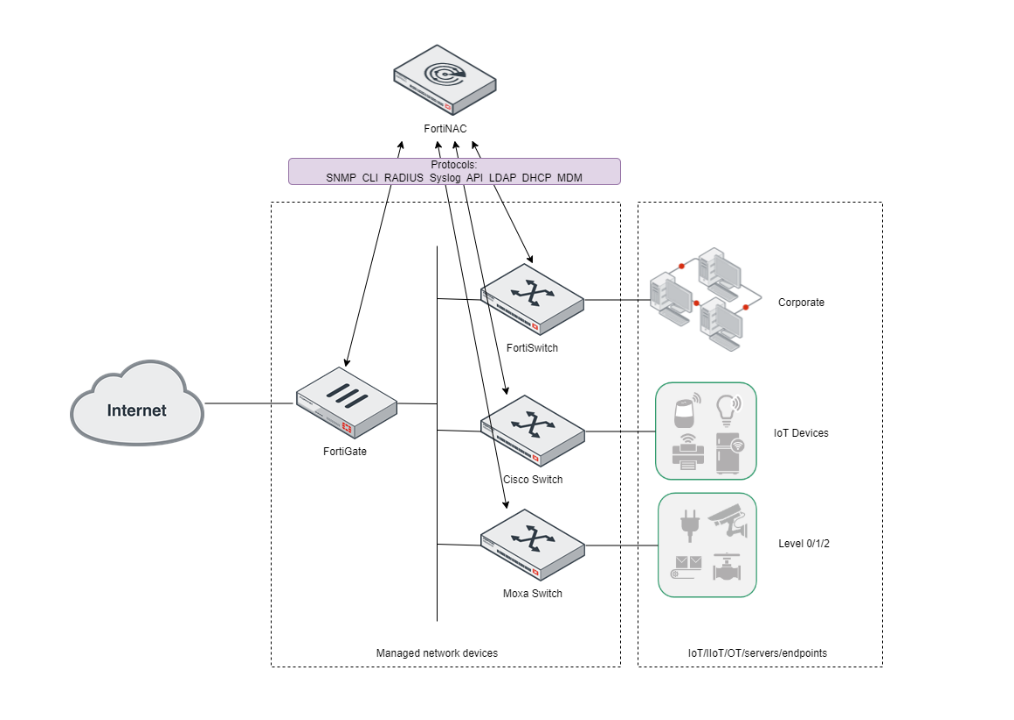
Sample Design:
Conclusion
The implementation of FortiNAC enhanced the organization’s ability to secure its internal network by improving device visibility, automating access control, and integrating seamlessly with the Fortinet Security Fabric. These capabilities helped reduce potential security exposures while streamlining day-to-day network operations.
As organizations continue to embrace bring-your-own-device (BYOD) programs, Internet of Things (IoT) technologies, and hybrid work models, Network Access Control (NAC) solutions are becoming increasingly important. By helping organizations identify, manage, and secure every connected device, FortiNAC provides a strong foundation for building a resilient and Zero Trust-ready cybersecurity environment.


No Comments