
 Finland
 Germany
 Denmark
 Sweden
 Italy
 Netherlands
 Norway














A security team’s curriculum should reflect the site it protects, client specifications, each officer’s authorized responsibilities, and the skills needed for safe, consistent performance. Developing a custom training curriculum for a security team means combining those requirements with role-based access instruction and ongoing practice, rather than relying on one generic course for every assignment.
Written procedures matter, but officers also need to apply them when making access decisions, responding to changing conditions, and communicating during incidents. A useful plan connects expectations to observable actions, then reinforces them through relevant exercises and regular assessment.
This article explains how to shape lessons around client and company requirements, define role-based authorization, identify skill gaps, and structure in-service training for scenarios such as crowd management and emergency response. It also explains how Insoft Services’ authorized networking training and professional services can support organizations with network access and technical training needs.
Customizing lesson plans for client or company specifications
Start with the client’s site procedures, access rules, and incident priorities. Translate each requirement into a lesson and an observable task. For example, at a site with network-controlled doors, connect credential checks with the steps to take when access fails.
Skill-Level Curriculum Structure
Organize the curriculum into foundational, role-specific, and advanced lessons, assigning each according to demonstrated responsibilities. New officers can practise entry checks and incident reporting; supervisors can work through escalation decisions and team coordination. For network roles, build from credential handling to configuring or reviewing access policies. Use a skills assessment and feedback to decide what each person should learn next.
Hands-On Training Exercises
Use exercises that reproduce the decisions people must make on the job. A physical-security drill can ask officers to monitor entrances, identify overcrowding, communicate by radio, and guide people toward designated exits. A cybersecurity exercise can simulate a failed 802.1X login or VPN request, then have participants trace authentication, authorization, and accounting records. Debrief each incident against the written procedure.
Training for Physical, Cybersecurity, and Hybrid Teams
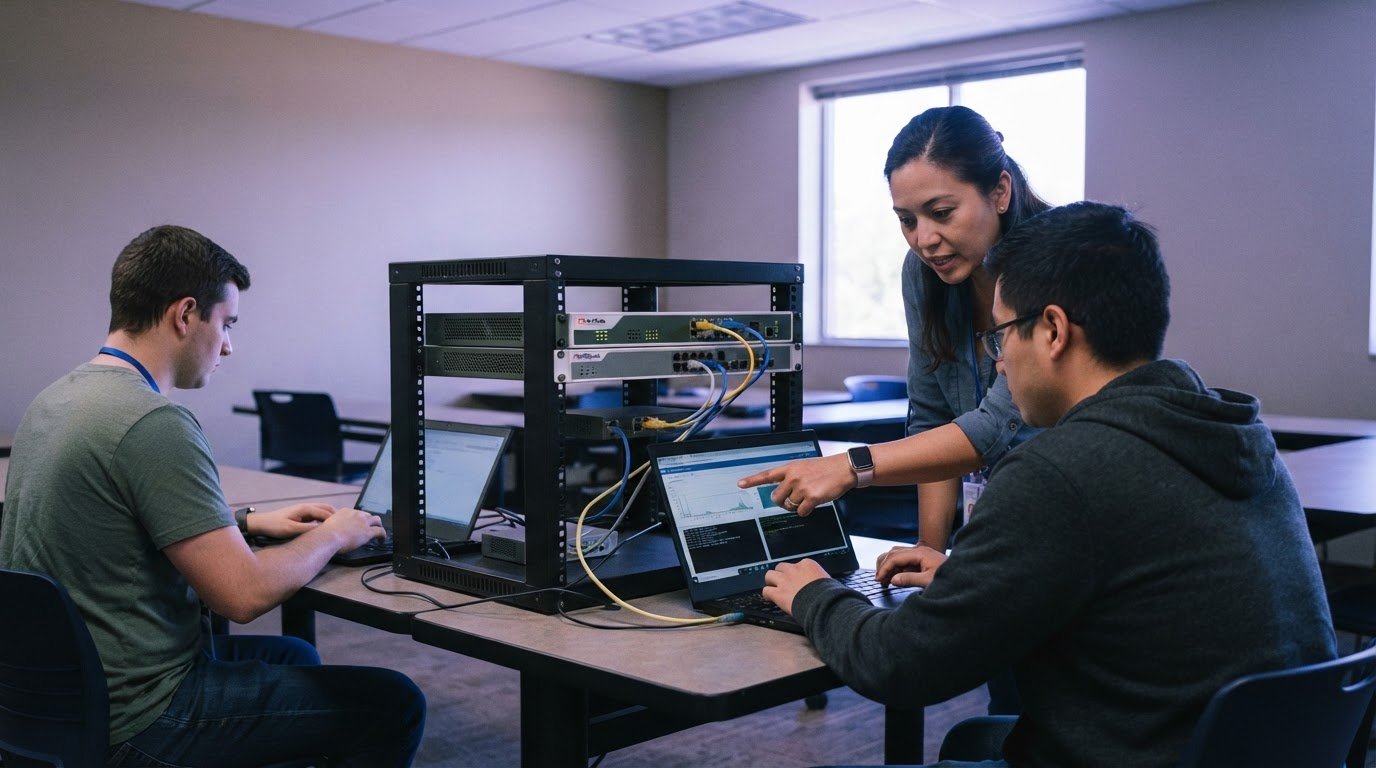
Physical teams need practice with access checks, crowd observation, calm de-escalation, and emergency communication. Cybersecurity teams need instruction on credentials, device access, and network controls; RADIUS commonly supports end-user access such as 802.1X and VPN. Hybrid teams should rehearse one shared incident, such as a lost credential triggering a physical access review and account investigation. Technical learning can also include Extreme Networks training.
Make client specifications traceable in the lesson plan by recording each requirement, responsible role, exercise, and evidence of completion. In network access modules, explain that AAA means Authentication, Authorization, and Accounting: authentication verifies identity, authorization determines permitted actions, and accounting records activity. This structure links written expectations to practical decisions and reviewable records.
Role-based authorization and least privilege
Assign access by job function, not individual preference. List each department’s tasks, systems, and sensitive resources, then map every task to the minimum permission it requires. A receptionist may verify visitor identity and record entry, while a supervisor approves exceptions. This makes authorization teachable: staff learn which actions their role permits and when to escalate. Use realistic account examples rather than abstract permission labels.
The AAA framework connects identity checks with authorization and recorded activity. In a client/server model, a network device can send an access request to a central server. RADIUS commonly supports end-user access, including 802.1X and VPN, while TACACS+ separates authentication and authorization. Network engineers can practise assigning role-specific commands through secure management protocols, then reviewing command logs. The exercise connects permitted actions with accountability.
Turn least privilege into scenarios for each department. A sales user may view and edit CRM records but lack user-management rights. An administrator handling network changes needs only the commands and systems required for that work. In each exercise, ask learners to identify the user, requested resource, permitted action, and activity record. Then introduce an out-of-role request and practise refusing or escalating it.
- Document each role’s required access and the business task it supports.
- Test authorization using routine requests and exceptions drawn from work procedures.
- Review logs to determine whether recorded activity matches the approved role.
Teach access boundaries as operational decisions, not merely configuration settings. For specialized infrastructure environments, role-focused technical learning can include Insoft Services authorised training, helping teams build knowledge relevant to the network technologies they use.
Authentication, authorization, and accounting (AAA) is a framework for managing user access, enforcing policies and privileges, and measuring network resource consumption. TACACS+ can authenticate engineers, authorize role-specific administrative commands, and log actions entered. Identity and access management combines technology and organizational policies to verify user identity, control access to resources and data, and log activity for auditing and compliance.
Privileged access management tools can support AAA by setting policies that protect sensitive data and enforce least privilege. For example, AAA authorization can limit a sales user to CRM software and allow data viewing and editing while restricting user management. These controls align role permissions with operational needs and support oversight of sensitive access.
Security officer in-service training
In-service training keeps procedures usable after initial instruction. Shape it around observed performance, recurring risks, and changes to site operations.
Training Needs and Skill-Gap Assessment
Assess performance through direct observation, practical exercises, and supervisor feedback. For example, review how officers handle an access-control exception, communicate during a crowd incident, and complete the required report. Compare what you observe with the site procedure, identify the skill that needs practice, and use regular assessments to guide refresher lessons.
Core Security Team Competencies
A security curriculum should develop skills in access control, identity verification, clear communication, incident reporting, and emergency response. Physical officers can practise monitoring entrances, noticing overcrowding, and using calm language to de-escalate conflict. Technical roles need to understand how user databases, administrator permissions, and application access affect security. Include accounting records so learners can interpret activity logs during an incident review.
Effectiveness and ROI Measurement
Measure effectiveness by comparing performance before and after training against the same task criteria. Track whether officers follow entry procedures, document incidents accurately, and communicate key details during drills. Review assessment results, supervisor feedback, and recurring errors to identify where refresher instruction is useful. To assess ROI, compare the effort invested in training with operational outcomes, such as fewer procedural gaps or more complete incident records.
Certification Pathways for Team Members
Choose cybersecurity learning by the systems each team member supports. A network administrator responsible for Fortinet configuration needs different technical development from an officer focused on physical access control. Align course content with current duties, then connect advanced learning to the technologies used across the organization. Teams working with Fortinet can explore its Fortinet certification track as a structured route for relevant technical development.
Keep in-service training active through regular sessions, refresher practice, and emergency drills. Scenario exercises can cover medical incidents, fires, and evacuation communication, with clear routes and instructions in each. Afterward, review observations and reports, then update lessons when procedures or team responsibilities change.
How to assess security team training needs and skill gaps
Start with role expectations and compare them with observable performance. A practical starting point for developing a custom training curriculum for a security team is to link each gap to a work task, not a broad label such as “communication.” For example, note whether an officer gives clear radio updates during an evacuation exercise or an administrator follows the approved process when reviewing a network access request.
Use several sources of evidence so lessons are not shaped by one isolated incident. Review supervisor feedback, exercise observations, incident reports, access records, and employee self-assessments. Look for patterns: repeated omissions in reports may point to a documentation skills gap, while confusion about escalation may indicate unclear responsibilities or a need for practice. Distinguish knowledge gaps from process problems before assigning training.
- Define the task. Identify the procedure, role, and expected action, such as verifying visitor identification at a reception point.
- Observe performance. Use a scenario or supervised task, then record the specific action completed or missed.
- Compare evidence. Review observations alongside feedback and records to distinguish an individual need from a team-wide issue.
- Set the learning response. Match the gap to instruction, coached practice, a procedure update, or a follow-up assessment.
Prioritize gaps according to their relationship to site access, incident response, and sensitive systems. A missed visitor log and an incorrect administrative permission call for different lessons, even if both involve procedure. Assign each action an owner, a learning objective, and a way to demonstrate progress. This makes the curriculum traceable from an observed need to practical development.
Repeat the assessment after training using the same task criteria. If officers still miss required details in an incident report, revise the practice scenario and review the reporting steps. If technical staff struggle to interpret network access records, focus the next exercise on those records. The assessment process for developing a custom training curriculum for a security team should also map technical gaps to relevant technology training courses and align learning with each role’s systems and responsibilities.
Insoft Services
Insoft Services supports organizations whose security curriculum includes network access, cybersecurity, or Fortinet technologies. Its authorized vendor training helps technical teams build skills aligned with the systems they administer, while Fortinet professional services support the implementation and configuration of Fortinet solutions. These offerings are suited to skill gaps in network security operations, not physical guard duties or crowd management.
Use assessment findings to define the next step: identify the technologies involved, the roles that need development, and the operational tasks learners must perform. This connects technical training to wider security objectives without assuming every team has identical needs.
Contact Insoft Services to discuss authorized technical training or Fortinet professional services, or visit insoftservices.uk.
Build capability for what comes next
A curriculum can evolve as your organization’s technology, responsibilities, and client requirements change. Treat each learning plan as a working capability framework: connect new skills to the systems teams support, then adapt development as those systems and roles grow. This keeps technical learning relevant without treating it as a replacement for site-specific physical security instruction.
For teams responsible for network environments, Insoft Services offers Official Cisco Training as a Cisco Learning Partner, Fortinet authorised training as a Premier Authorised Training Center (ATC), and Extreme Networks authorised training. These courses can support a technical development path shaped around the platforms your staff use.
Use your identified priorities to plan the next stage of developing a custom training curriculum for a security team, with learning aligned to real responsibilities and future readiness. Contact Insoft Services about training to discuss your team’s technical learning needs. A focused next step can help your people continue building capability with confidence.
Frequently Asked Questions
How to create a role-based security training plan?
Developing a custom training curriculum for a security team starts by mapping each role’s access and decisions to its actual risks. Set separate objectives for SOC analysts, network administrators, and incident leads. For example, analysts can practise triaging a suspicious login, while administrators rehearse isolating an affected system. Add assessed exercises, record results, and revise content when tools, responsibilities, or threat exposure change.
How often should security teams receive training and refresher courses?
Provide role-specific instruction before staff take on security-sensitive duties, then set refresher intervals according to applicable rules and documented risk. There is no single federal refresher schedule for every US security team. Revisit procedures after an incident, a system change, or an exercise exposes a gap. Use scenario drills to check that staff can perform tasks, rather than relying only on attendance records.
What legal and compliance requirements apply to security team training in the United States?
US training requirements depend on team duties, sector, and state law; there is no single nationwide curriculum or refresher interval. Where an OSHA standard requires an emergency action plan, OSHA requires employers to review it with covered employees when it is developed, upon initial assignment, and when responsibilities or the plan change. HIPAA-covered entities must train workforce members as necessary and appropriate, according to HHS. State licensing rules can add requirements for certain guard duties.

No Comments