

Cisco Training Courses

Cisco Training Courses

Insoft has been serving IT industry with authorized Cisco courses training, since 2010. Find all the relevant information on Cisco training on this page.

View More

Cisco Certifications

Experience a blended learning approach that combines the best of instructor-led training and self-paced e-learning to help you prepare for your certification exam.

View More

Cisco Learning Credits

Cisco Learning Credits (CLCs) are prepaid training vouchers redeemed directly with Cisco that make planning for your success easier when purchasing Cisco products and services.

Have CLCs and want to redeem them?

Cisco Continuing Education

The Cisco Continuing Education Program offers all active certification holders flexible options to recertify by completing a variety of eligible training items.

View More

Cisco U

Cisco U. is customized to achieve your learning needs as this provides learning paths that includes wide range of topics, including CCNA, Cloud and Network Automation Essentials.

Browse Catalogue

Cisco Business Enablement

The Cisco Business Enablement Partner Program focuses on sharpening the business skills of Cisco Channel Partners and customers.

View More

Fortinet Technical Certifications

Insoft Services´ training capabilities rely on the excellence of our exclusive Fortinet Certified Trainers (FCT). We are dedicated to providing high-quality training to Fortinet Customers and Partners.

View More

Fortinet Technical Courses

Insoft is recognised as Fortinet Authorized Training Center in selected locations across EMEA.

View More

ATC Status

Check our ATC Status across selected countries in Europe.

View More

Fortinet Services Packages

Insoft Services has developed a specific solution to streamline and simplify the process of installing or migrating to Fortinet Products.

Browse Packages

Prepforce Bootcamp

The only comprehensive source available today to prepare for Fortinet NSE 8 certification globally.

View More

Microsoft Training

Insoft Services provides Microsoft training in EMEAR. We provide Microsoft technical training and certification courses that are led by world-class instructors.

View More

Technical Training

The evolution of Extreme Networks Technical Training provides a comprehensive progressive pathway from Associate to Professional accreditation.

View More

ATP Accreditation

As an authorised training partner (ATP), Insoft Services ensures that you receive the highest standards of education available.

View More

Technical Training

The training includes self-paced labs for hands-on AWS practice in real-life scenarios, allowing you to learn at your own pace, in class, at work, or online.

View More

AWS Certifications

Having AWS certification means being on top of new and emerging cloud computing technologies that guide business transformation and growth, giving IT professionals and enthusiasts a significant advantage.

View More

AWS Certification Track

Explore AWS certifications designed for diverse roles, offering career growth, skill enhancement, and practical exam preparation to excel in cloud computing and AI technologies.

View More

What we do

Through our global presence and partner ecosystem, we provide strategic IT consulting services to align IT services with customers' business goals.

View More


We are pleased to launch pre-scoped Enterprise Networking Consulting Packages, our ready-made solutions, tailored to ensure efficiency and cost containment.


View More


We specialize in the deployment of vendor-specific automation tools as well as open-source and vendor-independent solutions, that can be tuned in accordance with the business needs of a specific organization.


View More


We provide comprehensive IoT consultancy, deployment and support solutions for businesses that want to launch or improve their use of connected technologies.


In a world where technologies are evolving rapidly, every company - business needs a partner to rely on and trust for the smooth and secure operation of its network infrastructure.

View More


In a world where technologies are evolving rapidly, every company - business needs a partner to rely on and trust for the smooth and secure operation of its network infrastructure.

View More


In a world where technologies are evolving rapidly, every company - business needs a partner to rely on and trust for the smooth and secure operation of its network infrastructure.


View More


In a world where technologies are evolving rapidly, every company - business needs a partner to rely on and trust for the smooth and secure operation of its network infrastructure.


View More
Cisco Training Courses


We provide the highest level of expertise on Cisco consultancy services, that target audits of your current network and implementing updates for improved operational performance, secure data and compliant systems.

View More


We provide the highest level of expertise on Fortinet consultancy services that target audits of your current network and implementing updates for improved operational performance, secure data and compliant systems.

View More


Our team can help enterprises, get the most value from Extreme products and services following our predefined value-added packages or custom ones that fits business needs.


View More


TXOne Networks provides cybersecurity solutions that ensure the reliability and safety of ICS and OT environments through the OT zero trust methodology protecting assets for their entire life cycle.


View More

About Us

Our training portfolio includes a wide range of IT training from IP providers, including Cisco, Extreme Networks, Fortinet, Microsoft, to name a few, in EMEA.

View More

Developing a Cybersecurity Upskilling Program for an IT Team: A Strategic Guide

Developing a Cybersecurity Upskilling Program for an IT Team: A Strategic Guide

Developing a Cybersecurity Upskilling Program for an IT Team: A Strategic Guide

13 April 2026

Could your organization withstand a sophisticated breach if 62% of your IT staff admit they lack the specialized skills to manage cloud-native security threats? According to the 2023 ISC2 Cybersecurity Workforce Study, the global talent gap has expanded to 4 million professionals; this makes developing a cybersecurity upskilling program for an IT team a strategic necessity rather than a luxury. You likely recognize that hiring your way out of this crisis is prohibitively expensive, particularly when the average recruitment cycle for a security architect now spans 150 days.

You’ll discover how to design a professional framework that aligns vendor-authorized training from global leaders with your specific technical requirements. We’ll examine the strategic integration of multi-vendor certification tracks to ensure your infrastructure remains resilient and future-ready. This approach empowers your current workforce to achieve technical mastery while providing a clear, structured roadmap for long-term organizational growth and digital agility. By investing in your existing talent, you ensure your defense capabilities evolve as rapidly as the threats they’re designed to stop.

Assessing the Cybersecurity Landscape: Identifying Critical Skill Gaps

Developing a cybersecurity upskilling program for an IT team requires moving beyond reactive training toward a structured, strategic framework. This initiative empowers existing staff to evolve alongside the threat landscape. A successful program begins with a rigorous audit of current infrastructure against the actual competencies of your technical personnel. This process isn’t merely about checking boxes; it’s about ensuring your team understands the core principles of information security while mastering the specific tools they manage daily.

Organizations must distinguish between basic security awareness and professional-level technical mastery. While general staff need to recognize phishing, your IT team must possess the depth to architect Zero Trust environments or manage Security Operations Center (SOC) workflows. Transitioning a Network Engineer into a security-centric role involves mapping their existing knowledge of routing and switching to advanced defense-in-depth strategies.

Inventorying Technical Competencies

Effective assessment utilizes a granular skills matrix to evaluate proficiency in areas like firewall management and incident response. Aligning these criteria with the NIST Cybersecurity Framework provides a globally recognized benchmark for excellence. For example, an administrator proficient in basic connectivity might require specialized training, such as the FortiOS Administrator course, to handle sophisticated threat detection and automated response protocols within a modern security fabric.

Defining Strategic Objectives for 2026

Forward-thinking leaders set specific, measurable targets to ensure business agility. By the end of Q4 2025, your objective might be achieving a 90% team certification rate in advanced network defense. Whether the focus is cloud security or IoT protection, these goals must be precise. Developing a cybersecurity upskilling program for an IT team ensures that by 2026, your infrastructure isn’t just maintained but actively defended by experts who hold multi-vendor mastery. This strategic depth transforms IT from a support function into a resilient pillar of organizational growth.

Architecting a Multi-Vendor Strategy: Selecting Authorized Pathways

Developing a cybersecurity upskilling program for an IT team requires more than a single-vendor focus. Organizations that rely on a solitary provider risk technical blind spots; therefore, integrating a multi-vendor strategy is essential. This approach prevents vendor lock-in and builds a robust, layered defense. High-quality training relies on authorized learning partners to guarantee that the curriculum remains accurate and aligned with the latest threat intelligence. For example, CISA’s Project UpSkill provides foundational modules that complement these specialized vendor tracks. By combining government-led initiatives with vendor-specific mastery, you’re creating a defense-in-depth strategy that protects your enterprise from evolving vulnerabilities.

The Cisco Pathway: From CCNA to Security Specialization

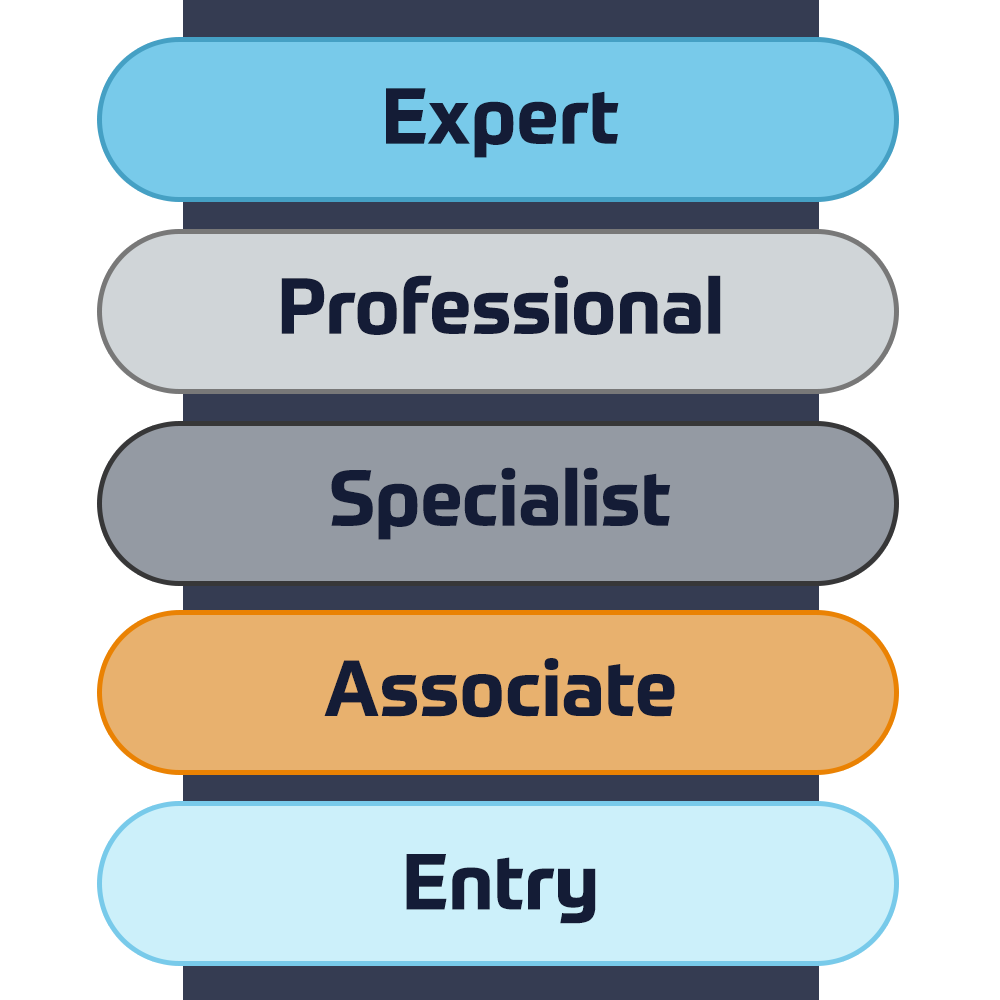
The Cisco certifications track offers a logical, structured progression for engineers. It starts with the CCNA, which provides the baseline networking knowledge essential for 85% of security roles. Moving into senior engineering, the CCNP Security focuses on advanced concentrations like firewalls and identity management. To support distributed workforces, Cisco Digital Learning offers the 24/7 flexibility global teams need to maintain their study pace without disrupting daily operations. It’s a scalable solution that ensures your team’s expertise remains sharp across every time zone.

The Fortinet Pathway: Mastery of Fabric Security

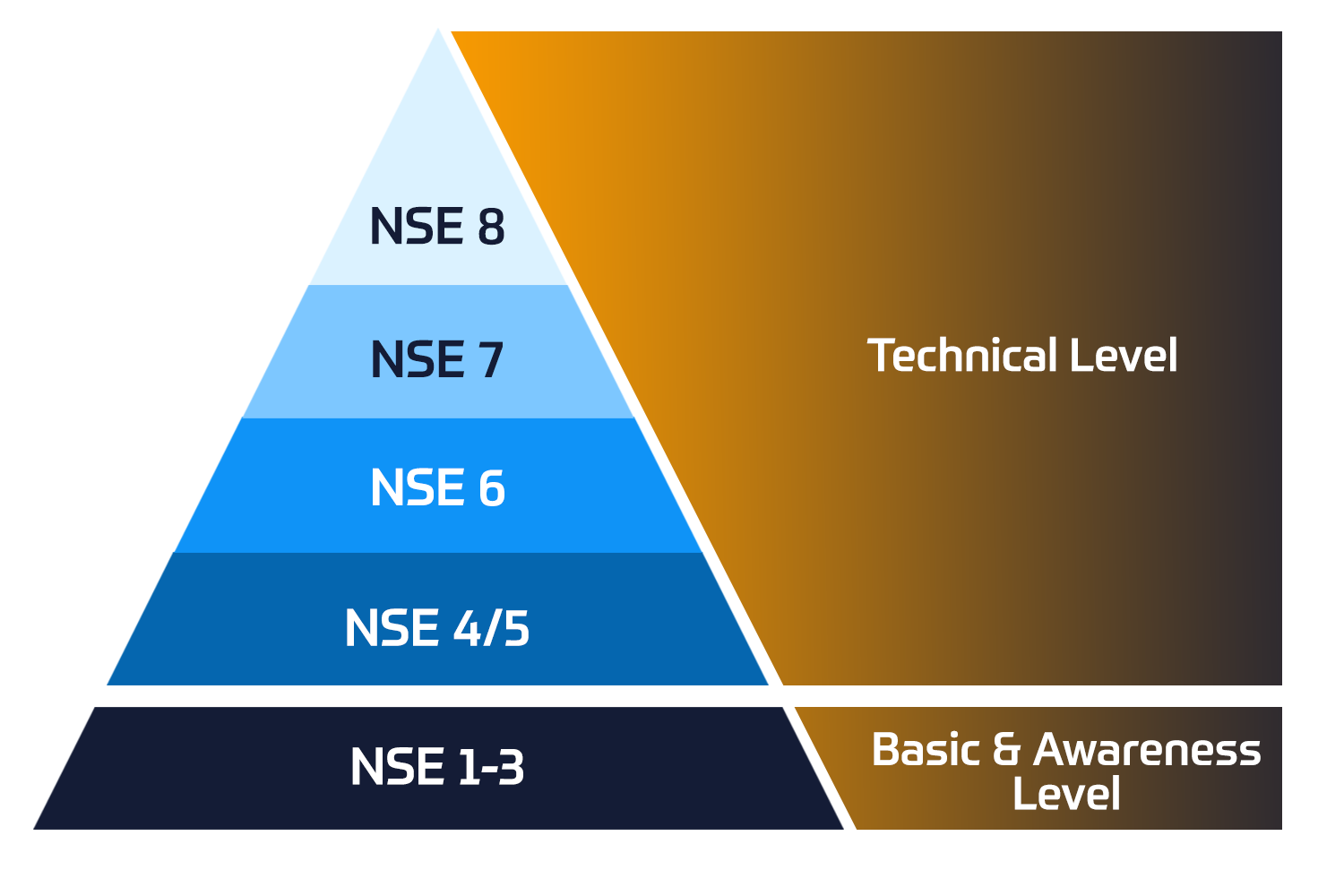
Fortinet’s approach emphasizes the Security Fabric, a unified architecture that connects disparate security devices. The Fortinet certifications track spans from NSE 1, focusing on cybersecurity awareness, to the elite NSE 8 expert level. For technical staff, the FortiOS Administrator course is critical for mastering day-to-day configuration and management. Developing a cybersecurity upskilling program for an IT team using these structured paths ensures that every professional reaches a measurable level of technical mastery. You might consider reviewing our full list of authorized vendors to identify the best fit for your specific infrastructure and long-term security goals.

  • Authorized Curriculum: Ensures training is based on the latest software versions and patches.
  • Strategic Flexibility: Multi-vendor training allows teams to pivot as the threat landscape changes.
  • Measurable Progress: Certification levels provide clear benchmarks for employee development and performance reviews.

Executing the Upskilling Program: Integrating Hybrid Learning Models

To begin developing a cybersecurity upskilling program for an IT team, leadership must view training as a strategic asset rather than a line-item expense. Securing executive buy-in requires presenting a clear ROI centered on risk mitigation. For instance, the 2023 IBM Cost of a Data Breach Report highlights that the average cost of a breach reached $4.45 million. You can justify the investment by showing how a skilled team reduces detection and containment times. Once you’ve secured approval, optimize your budget by utilizing Cisco Learning Credits or bulk training vouchers. This approach ensures that your financial resources are converted into high-value technical competencies without administrative friction.

The execution phase relies on a structured sequence of instruction and application. First, schedule instructor-led sessions to provide deep-dive technical guidance and mentorship from seasoned experts. These sessions should be followed by the implementation of hands-on labs. Within these sandbox environments, your team can practice incident response protocols safely. This methodical progression ensures that when developing a cybersecurity upskilling program for an IT team, the focus remains on operational readiness rather than just passive learning.

Blending Formal Instruction with Practical Application

Virtual Instructor-Led Training (VILT) offers a sophisticated solution for geographically dispersed teams, providing real-time access to global experts. This format maintains the rigor of traditional classrooms while offering the flexibility required by modern enterprises. Mastery is achieved when theoretical knowledge is immediately tested in authorized labs. This immediate application solidifies concepts and builds the confidence necessary to handle complex network security challenges.

Supporting Continuous Professional Development

Empowerment is a key driver of long-term success. You should encourage a culture where team members receive at least four hours of dedicated “learning time” each week. This structured time allows professionals to pursue advanced specializations, such as AWS certification tracks, to address the growing needs of hybrid cloud security. Providing these pathways ensures your organization stays ahead of the digital evolution.

Ready to empower your workforce with expert-led instruction? Explore our comprehensive technology training courses to begin your strategic transformation today.

Measuring Program Efficacy and Sustaining Resilience

Success in developing a cybersecurity upskilling program for an IT team depends on rigorous validation and iterative refinement. Organizations shouldn’t view training as a one-time event; it’s a continuous cycle of improvement. Establishing key performance indicators (KPIs) such as a 25% reduction in Mean Time to Detection (MTTD) or a 90% first-time pass rate for advanced security certifications provides clear visibility into the program’s ROI. Leaders should integrate these outcomes into annual performance reviews, rewarding technical mastery with clear career progression paths. To ensure the highest standards, organizations often leverage Professional IT Consultancy to audit how new skills translate into hardened infrastructure security. Regular audits by external experts help bridge the gap between classroom knowledge and real-world application.

Tracking Certification Progress

Visibility is the cornerstone of accountability. We recommend maintaining a centralized dashboard that tracks individual trajectories through multi-vendor learning paths. This real-time oversight allows managers to identify bottlenecks where team members might struggle with complex modules. Celebrating milestones, such as an engineer attaining their first expert-level security credential, fosters a culture of excellence. By monitoring these metrics, the enterprise ensures that the investment in human capital yields tangible technical capabilities.

Adapting to the Future-Ready Enterprise

Developing a cybersecurity upskilling program for an IT team requires a commitment to long-term resilience. Conducting quarterly reviews ensures the upskilling roadmap incorporates the latest vendor releases and emerging threat vectors. This proactive stance ensures the organization remains resilient against sophisticated 2026-era threats, such as automated zero-day exploits. We invite your teams to explore our comprehensive vendor training portfolio to identify the next strategic growth area for your technical staff. Staying current with authorized training ensures your defense remains robust as the digital landscape shifts.

Securing the Future-Ready Enterprise Through Strategic Mastery

Building a resilient defense requires more than reactive measures; it demands a systematic approach to professional development. By identifying precise skill gaps through frameworks like the NIST Cybersecurity Framework and integrating hybrid learning models, organizations bridge the distance between current capabilities and future threats. Developing a cybersecurity upskilling program for an IT team isn’t just an HR initiative; it’s a critical strategic pivot that ensures your infrastructure remains robust against evolving exploits. Success hinges on a multi-vendor strategy that combines technical depth with practical application across diverse network environments.

We invite you to Empower your IT team with our Official Cisco and Fortinet Training Solutions. As an Authorized Cisco Learning Partner and a Premier Fortinet Authorized Training Center, Insoft Services provides global reach with localized expert delivery across 50+ countries. Our structured pathways provide the technical competence required for today’s complex digital landscape. We’re here to help your team achieve mastery and sustain long-term resilience through excellence. Your path to a more secure and agile enterprise begins with a commitment to continuous growth.

Frequently Asked Questions

How long does it typically take to develop a cybersecurity upskilling program?

Designing a comprehensive framework typically requires 12 to 16 weeks from the initial talent assessment to the first training delivery. This timeline includes a 21-day period for technical skill auditing and 30 days for curriculum mapping against organizational goals. By following this structured approach, leadership ensures that the training aligns with the 2024 threat landscape rather than outdated security protocols.

Is it better to focus on a single vendor like Cisco or a multi-vendor approach?

A multi-vendor strategy is more effective because 85% of modern enterprises operate in hybrid or multi-cloud environments. While Cisco provides a robust foundation for network security, developing a cybersecurity upskilling program for an IT team must include specialized training for AWS, Azure, and Palo Alto Networks. This holistic method empowers your staff to manage complex, interconnected systems without the limitations of a single-vendor ecosystem.

What is the most effective way to fund a large-scale IT upskilling initiative?

Funding is most effectively secured by allocating 2% of your total IT personnel budget and leveraging external training grants. Many regions offer digital transformation subsidies, such as the European Social Fund Plus, which can cover up to 70% of tuition costs for qualifying organizations. This strategic investment reduces the long-term expense of external hiring; SHRM reports that internal mobility is significantly more cost-effective than outside recruitment.

How do I ensure my IT team remains engaged throughout a long-term training program?

Engagement remains high when you integrate 10% of weekly working hours for dedicated learning and provide clear career progression paths. Data from the 2023 Global Knowledge IT Skills and Salary Report shows that 48% of professionals feel more motivated when their training leads directly to a recognized certification. It’s essential to use interactive labs and peer-to-peer mentoring to keep the experience practical and collaborative.

What are the risks of using unofficial or unauthorized training materials?

The primary risks include a 40% higher failure rate on certification exams and the potential for critical knowledge gaps in your defense posture. Developing a cybersecurity upskilling program for an IT team with unauthorized materials often means using content that hasn’t been updated for the latest CVEs or vendor patches. This negligence can lead to non-compliance with ISO 27001 standards and leaves your infrastructure exposed to avoidable breaches.

Insoft Services

  • Recent Blogs

  • No Comments

    Comments are closed.